
With global negotiations on a new plastics treaty stuck, the UK-based Environmental Investigation Agency (EIA) convened an early-morning briefing on Tuesday, 9 December in Nairobi on the sidelines of UNEA-7, to take stock of the stalled process, and explore how to break the deadlock.
The session brought together governments, civil society, rightsholders, private-sector representatives and academics.
Anchored in UNEA-7’s theme, “Advancing sustainable solutions for a resilient planet,” the discussion aimed to cut through the paralysis that followed the turbulent INC-5.2 talks in Geneva in August.
With no INC Chair in place and geopolitical tensions rising, speakers examined how countries could rebuild ambition, restore trust, and “fix the process” before the next negotiating round, INC-5.4.
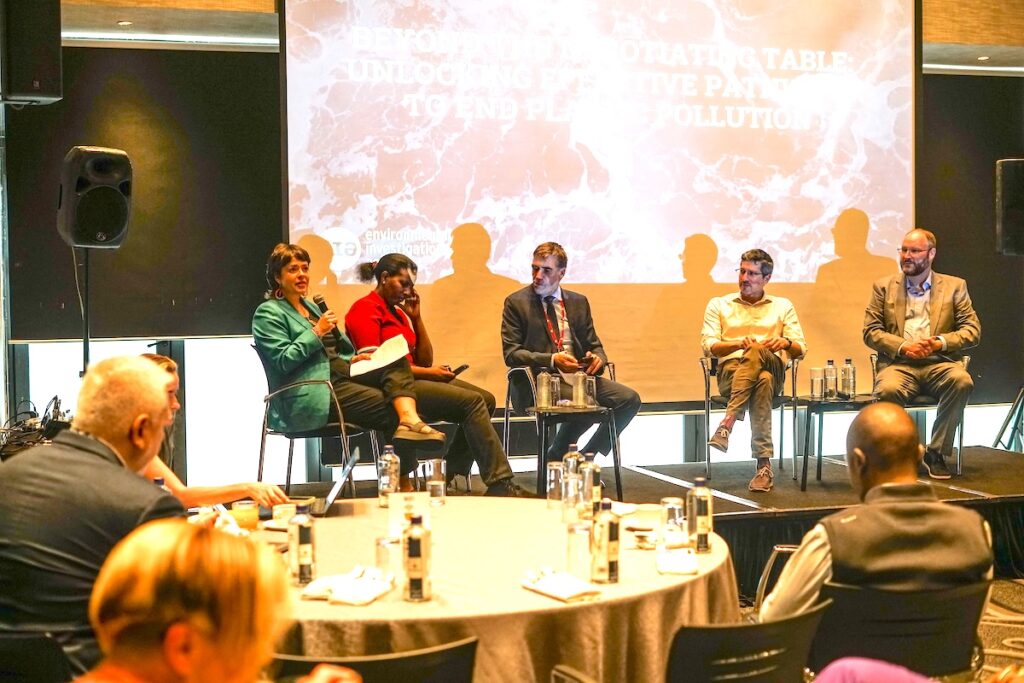
Dennis Clare, legal adviser to the Federated States of Micronesia, reminded participants that plastic pollution and climate change are deeply intertwined. Drawing on lessons from the Kigali Amendment negotiations, he urged negotiators to stay the course even when political winds shift.
While the global treaty is not on UNEA-7’s formal agenda, since it is negotiated separately by the Intergovernmental Negotiating Committee (INC), delegates acknowledged that the Assembly remains an important space for recalibrating political will.
Moderated by EIA’s Christina Dixon, the panel delivered an unusually candid appraisal of the obstacles ahead. New analysis released last week showed how chemical and petrochemical industry narratives, promoted before and during the August 2025 negotiations, contributed significantly to the breakdown of talks.
Those negotiations ended on 15 August with no agreement. On one side stood about 100 nations pushing for production limits and bans on harmful plastics.
On the other, major oil-producing countries such as Saudi Arabia, Russia and the United States, strongly opposed any measures that would curb plastic production.
Rwanda’s Juliet Kabera called on governments to enact strong national laws and use regional instruments rather than waiting passively for global consensus.
Of the 430 million tonnes of plastic produced every year, 350 million tonnes become waste and 52 million tonnes leak into the environment. Without decisive action, the UN warns that plastic pollution could triple by 2060.

UNEA first mandated a global plastics treaty in 2022, launching a process meant to conclude after five INC sessions. Instead, the talks have dragged with no agreement. UNEP has promised another negotiating session, but has yet to announce when or where. With the INC chair position now vacant, doubts over the treaty’s future are growing.
EIA Senior Lawyer Tim Grabiel cautioned that the process is increasingly vulnerable to bad-faith actors. Progress, he argued, now depends on restoring trust and establishing predictable rules.
Speakers also stressed the need for science-based decision-making to demonstrate that strong regulation can deliver economic, health and social benefits, and ensure a fair transition away from rampant plastic production.
Rebuilding trust emerged as one of the most urgent priorities. Participants called for full observer access, transparent communication, stable rules of procedure, and strong leadership from the next INC chair.
The meeting closed with a set of practical fixes for INC-5.4 that included empowering the chair, holding daily bridge-building sessions modelled on the Kigali process, ensuring all parties are prepared before reconvening, restoring full observer participation, and sustaining pressure both inside and outside formal negotiations.
With the dream of a historic global treaty hanging in the balance, the message from the forum indicated that progress will depend not only on technical solutions but also on political courage, procedural clarity, and a renewed commitment to collective action.