

By Mwangi Ndirangu
The Intergovernmental Authority on Development (IGAD) has warned that food insecurity across the Horn of Africa is worsening, driven largely by climate change-linked extreme weather and persistent drought conditions.
Speaking on the opening day of the 72nd Greater Horn of Africa Climate Outlook Forum (GHACOF 72) in Nairobi on Monday, scientists and policymakers highlighted that cycles of failed rains, rising temperatures, and climate variability are now directly threatening agricultural productivity, water supply, and livelihoods across IGAD member states.
IGAD’s Climate Prediction and Applications Centre (ICPAC) reported that the Greater Horn of Africa remains noted that recurrent droughts, floods, and heat stress are increasingly undermining food and pasture security.
According to the IGAD Regional Focus of the 2025 Global Report on Food Crises, an estimated 42 million people across six East and Horn of Africa countries (Kenya, Somalia, South Sudan, Sudan, Djibouti, and Uganda) are facing high levels of acute food insecurity this year.
The figures reflect a sharp rise in hunger over the past decade, with the number of people experiencing severe food shortages in five of these countries nearly tripling since 2016.
IGAD officials stressed that although some rainfall in 2024 and early 2025 briefly improved crop and livestock production, gains were quickly erased by intense flooding, continuing conflict, and economic shocks that limited access to food and critical resources.
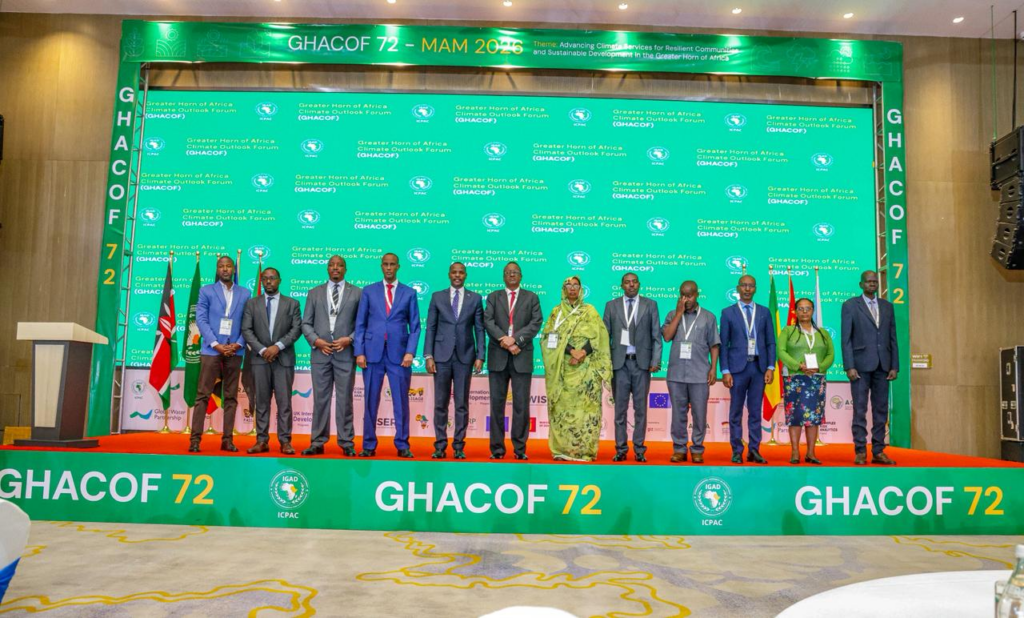
Experts at GHACOF 72 underlined that climate change is a present reality shaping food security in the region. Higher temperatures, erratic rainfall patterns, and prolonged dry spells have dramatically altered seasonal cycles that farming and pastoral communities depend on.
“The frequency and severity of droughts and other extremes are undermining crop yields, shrinking pastures and intensifying water scarcity,” said an ICPAC representative. “These climate shocks are now a defining threat to food production and livelihoods.”
In Kenya, for example, failure of the 2025 short rains has left large arid and semi-arid lands in drought alert or alarm phases, prompting concerns over water stress and loss of grazing land for livestock herders.
IGAD officials called for strengthened early warning systems, better climate forecasts, and enhanced regional cooperation to prepare for and respond to climate risks before they escalate into full-blown humanitarian crises.
The regional bloc has been supporting initiatives aimed at building resilient food systems, including programmes to boost climate-smart agriculture, improve adaptive capacity of communities, and reinforce cross-border collaboration on drought and flood management.
However, experts emphasise that tackling food insecurity in the Horn of Africa requires not just humanitarian response but long-term investments in climate adaptation, sustainable water use, and strengthened rural livelihoods.