
By Christopher Clark
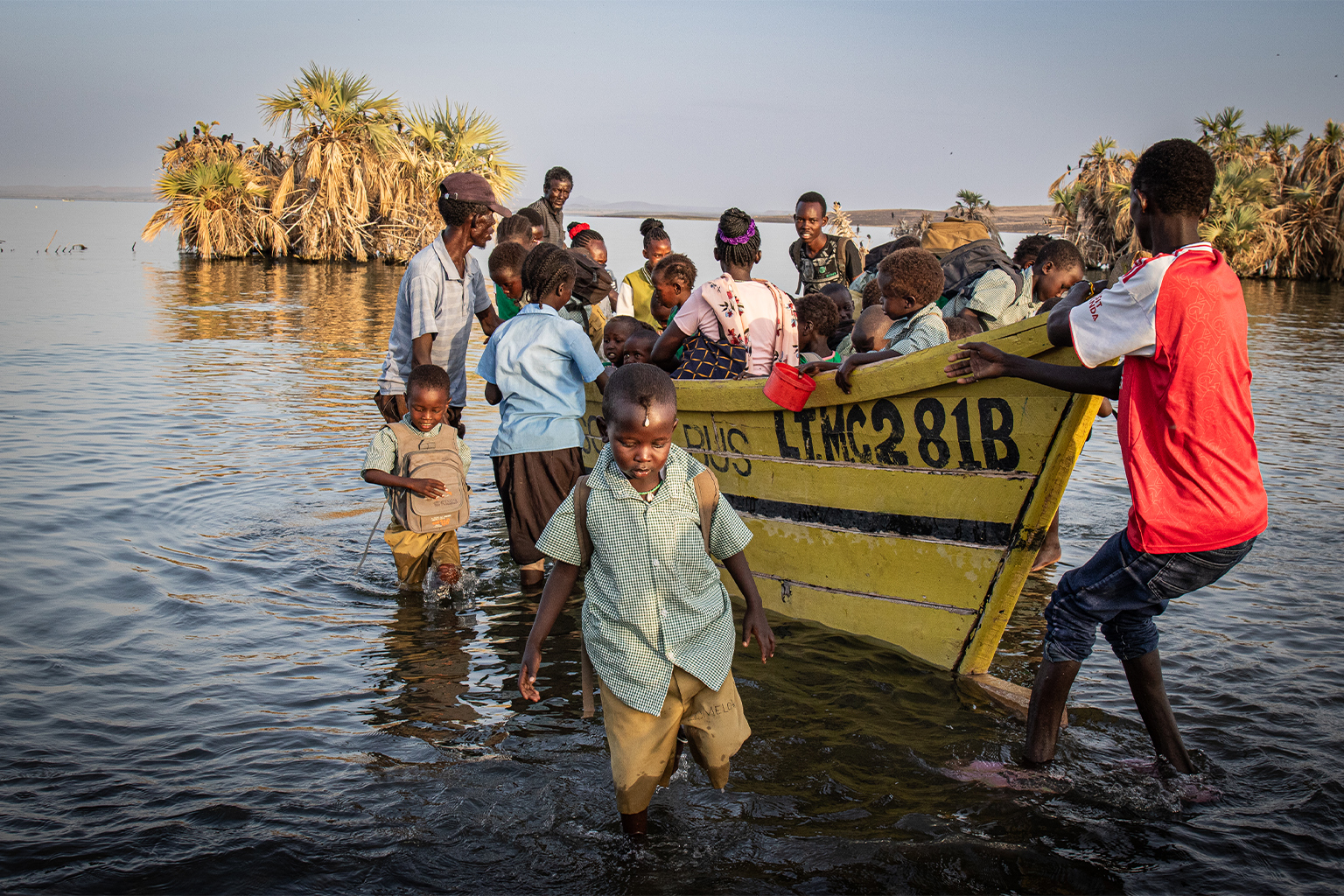
At sunrise on Komote Island, 36-year-old James Lekubo walks his two children down a rocky hillside to the water’s edge. They climb into a small fishing boat alongside a couple of dozen other passengers, setting off across a stretch of water that did not exist a few years ago. On the far side lie the school and the nearest clinics, which were once within walking distance before the lake rose and swallowed the land between them.
Lekubo belongs to the El Molo, one of Kenya’s smallest and most marginalised communities, who have lived for generations along the eastern shores of Lake Turkana. For centuries, the lake has sustained them, shaping their culture, diet, and identity. But in recent years, the world’s largest desert lake has begun to transform in ways that threaten not only their livelihoods, but their very existence as a distinct people.
Over the past decade, Lake Turkana’s water levels have risen dramatically, driven largely by heavier rainfall in the Ethiopian highlands that feed the lake through the Omo River. According to a 2021 report by Kenya’s environment ministry, over the preceding decade, Turkana’s water levels rose by several meters, expanding the lake’s total surface area by around 10%.
Since then, the lake has continued to grow, submerging up to 1,000 square feet of the surrounding landscape, including roads, grazing land, ancient burial sites, and even entire villages.
Komote is one of the places most visibly altered. As the lake expanded, it gradually cut the area off from the mainland, turning it into an island. Lekubo watched helplessly: “Most people left as the water came up. Even my family has been separated. I have cousins and uncles who are now on that side,” he says, gesturing at the new shoreline about 600 meters away. “I don’t really see them anymore.”
Lekubo, his wife, and children are among the few dozen El Molo households that have so far refused to leave the newly formed island, despite additional obstacles and repeated calls from the government of Marsabit County for them to relocate to mainland villages. “This is my home,” Lekubo says. “It is what I know.”
But it may only be a matter of time. Rising water levels have altered nearshore ecosystems, flooding fish breeding grounds and changing migration patterns. For communities like the El Molo, whose lives revolve around fishing, the consequences are immediate and severe.
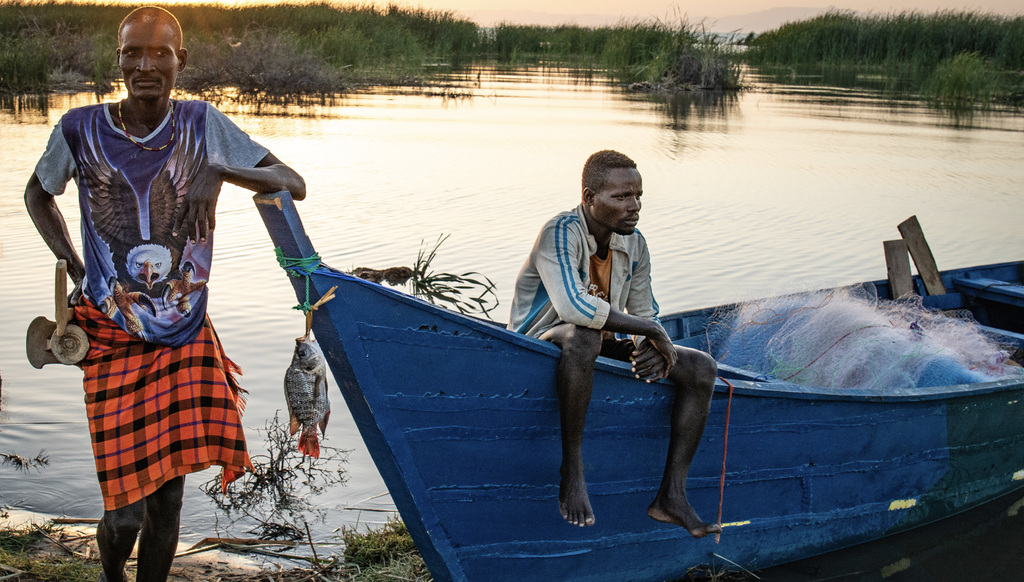
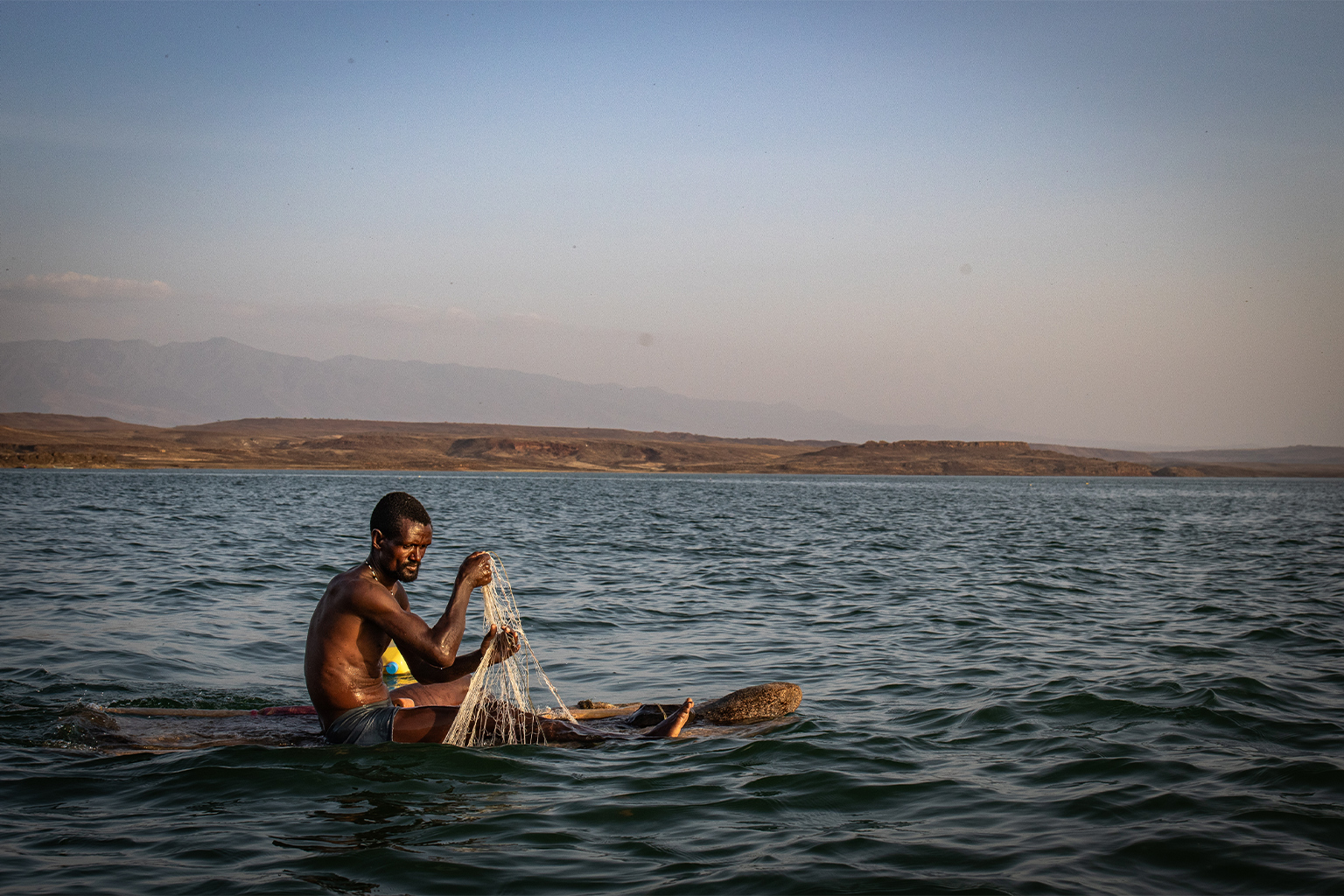
Lekubo has fished these waters since he was a teenager. Today, he says his monthly catch has dropped by more than half. “It’s not enough,” he admits.
Across the lake, similar stories echo. On the opposite shore, Lucy Lenapir runs a small roadside kiosk selling chapati and chai to fishermen and traders. She has watched the changes unfold over time. “The men still go out to fish because there is no other option,” she says. “But there are no more fish.”
The pressure on the lake’s fisheries extends far beyond the El Molo. Over the past two decades, fishing on Lake Turkana has expanded rapidly, transforming from a relatively small-scale activity into a critical economic lifeline for hundreds of thousands of people.
Much of this shift has been driven by climate stress elsewhere. Prolonged drought across northern Kenya and southern Ethiopia has devastated pastoralist communities, killing livestock and pushing herders toward fishing as an alternative source of income. At the same time, improved infrastructure and growing urban demand have made it easier to transport fish to distant markets, drawing more people into the sector.
A comparison of recent estimates from a 2024 World Food Programme (WFP) report and historical government fisheries data suggests the total number of fishers on the Kenyan side of Lake Turkana has more than doubled, from around 7,000 to more than 14,000, in the last 15 years.
“More people are coming to fish every day,” says Stephen Ekuwom, a community fisheries leader in Kalokol. “They are coming from all over.”
As competition intensifies, fishing practices have also evolved. Traditional wooden boats and handwoven nets are increasingly being replaced or supplemented by motorized vessels and larger, more efficient gear capable of reaching deeper waters. While this has temporarily boosted catches, it has also accelerated the depletion of key fish species.
Researchers studying the lake have observed a notable shift in fish populations. Larger, commercially valuable species such as tilapia and Nile perch are becoming harder to find, replaced by smaller fish that reproduce quickly but fetch lower prices.
This ecological shift is reflected in production trends. While total fish output rose significantly over the past decade, recent figures suggest a decline, attributed in part to rising water levels that have made traditional fishing grounds less accessible.
Kenya Fisheries Service statistics show fish production on Lake Turkana rising from 6,430 metric tons in 2010 to 17,251 metric tons in 2022, before falling to around 15,600 metric tons in 2023, the most recent year for which full data are available. The WFP report attributes this decline to rising water levels restricting access to fishing grounds.
The consequences are not just economic as they are increasingly becoming social and political. As fishermen travel farther in search of dwindling stocks, tensions have escalated in contested areas, particularly along the Kenya–Ethiopia border.
In recent years, clashes between Turkana and Dassanech fishers have intensified, sometimes turning deadly. In 2025, more than 20 fishermen were killed in an attack near Todonyang, underscoring the growing volatility around the lake.
For individuals like 32-year-old Kute Hero, the lake represents both survival and risk. Once a pastoralist, Hero lost nearly all his livestock to drought and turned to fishing as a last resort. “I had about 1,000 animals,” he says. “All of them died except for two goats and a sheep.”
The transition has been difficult, not only economically, but culturally. Among his community, fishing was once seen as a lesser occupation. Now, it is a necessity. “Fishing is very difficult,” he says.
Hero has also witnessed the rising violence firsthand. Not long ago, his boat came under fire while fishing near the border. A close friend was killed in the attack. “Now my family is crying every time I go back onto the lake,” he says.
To reduce the risk, he and others have begun fishing closer to shore. But this has further reduced their catches, compounding the hardship.
These overlapping pressures of rising waters, declining fish stocks, population influx, and conflict are converging at a time when climate forecasts suggest the situation may worsen. Scientists warn that increased rainfall in the lake’s catchment could drive further expansion in the coming decades, deepening the disruption already unfolding.
Lake Turkana has always been shaped by environmental variability. But what is happening now is different in both scale and speed. Multiple forces, climatic and human, are shifting simultaneously, creating a system that is increasingly difficult to predict.
Back on Komote Island, as the day draws to a close, Lekubo prepares for another night on the water. The wind softens, and the lake’s surface settles into a muted calm. He paddles out on a traditional log raft, casting his net into the deepening expanse. “We depend on this lake. It is our daily bread,” he says.
A few miles away, at the Desert Museum near Loiyangalani, artefacts tell the story of that enduring relationship with hand-carved harpoons, woven nets and tools fashioned from fish, reminding of a culture shaped by water.
Yet even here, the signs of erosion are evident. The El Molo population has dwindled, their language has disappeared, and many traditions have faded through intermarriage and modernization. “Many of our traditions have slowly disappeared,” said Lucas Lemoto, a caretaker at the museum. “Our language was already extinct when I was growing up.”
Across the Rift Valley, Lake Turkana is not alone. Other lakes, including Baringo, Bogoria, Naivasha, and Nakuru, have also expanded in recent years, submerging settlements and farmland, displacing communities, and redrawing landscapes. Together, they point to a broader environmental shift whose full consequences are only beginning to unfold.
This article has been republished from Mongabay: https://news.mongabay.com/2026/04/in-northern-kenya-a-shifting-lake-turkana-reshapes-traditional-livelihoods/