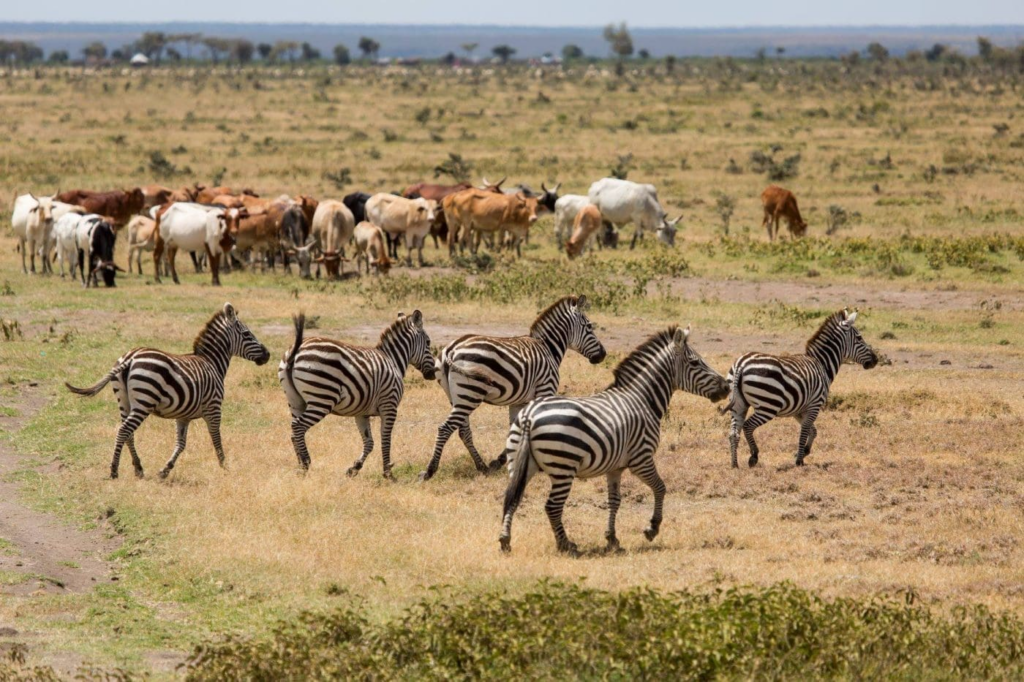

Large herds of cattle grazing in and around the Maasai Mara Conservancies are pushing lions out of traditional habitats, according to a new study.
The research, published in Biological Conservation, shows that although cattle and lions use the savanna at different times, with livestock grazing by day and lions active at night, the presence of large numbers of cattle still alters lion behaviour.
Researchers found that lions avoid areas with heavy cattle use, reducing the space available for the big cats in a landscape already shared with people.
Lead author Niels Mogensen, a Ph.D. student at Aarhus University, said the results are striking: “Lions have a natural fear of cattle and their herders, and as cattle numbers increase, it is the lions that retreat.”
The Maasai Mara Conservancies are community-run wildlife areas that border the famous Maasai Mara National Reserve and are crucial for both biodiversity and Kenya’s thriving nature-based tourism industry. The region is renowned for its dense populations of large predators and the annual wildebeest migration, attracting visitors from around the world.
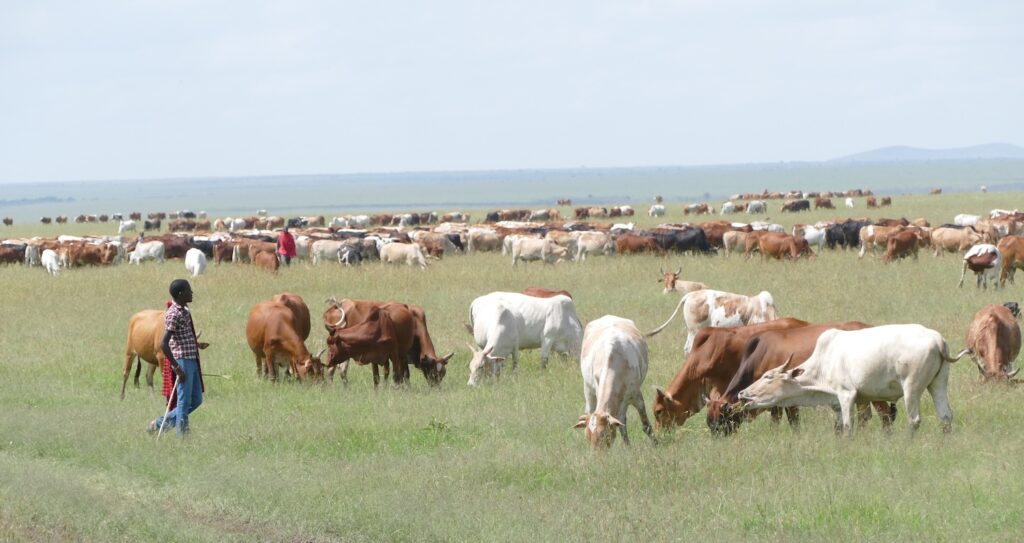
By dividing the study area into one-kilometre grid cells and systematically recording wildlife and livestock, the research team created spatial models of animal distributions over a nine-year period. Their analysis showed that lions tend to avoid grazing lands dominated by cattle, even where herders rarely harm the big cats directly.
Nearly 70 % of Kenya’s wildlife now lives outside formally protected national parks, often overlapping with communities that keep livestock, a trend that has reshaped predator-prey dynamics across the country.
Conservation experts warn that shrinking lion habitat could have cascading effects. Lions pushed into marginal areas may struggle to find prey, reproduce successfully, or maintain stable territories.
There is also concern that limited space could drive more predators closer to villages, increasing human-wildlife conflict.
To address these pressures, the study’s authors recommend more targeted grazing management. Strategies include maintaining lower cattle numbers in core wildlife areas, particularly near rivers and dense vegetation where lions rest, and rotating grazing sites so that important habitats can recover.
“We now have a detailed picture of how lions respond to livestock. That knowledge should be used directly in management so that grazing decisions are based on evidence rather than assumptions,” says Mogensen
The research offers a path toward coexistence if communities, conservationists, and policymakers work together.