
By Agencies
The symbolic Doomsday Clock has moved perilously closer to midnight, its closest position in history, as scientists warn that accelerating climate change, alongside nuclear risks and emerging technological threats, is pushing humanity toward a world-ending catastrophe.
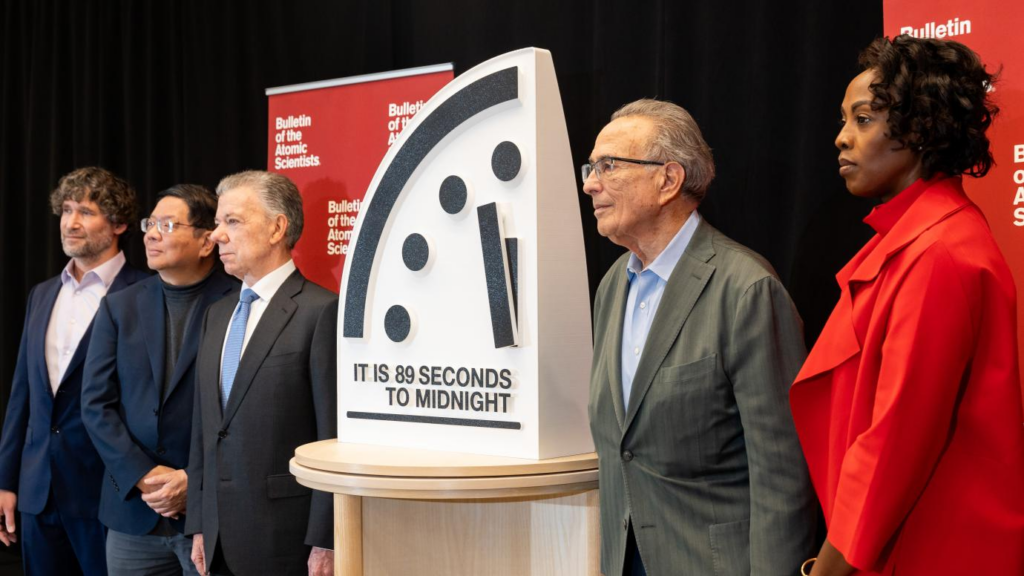
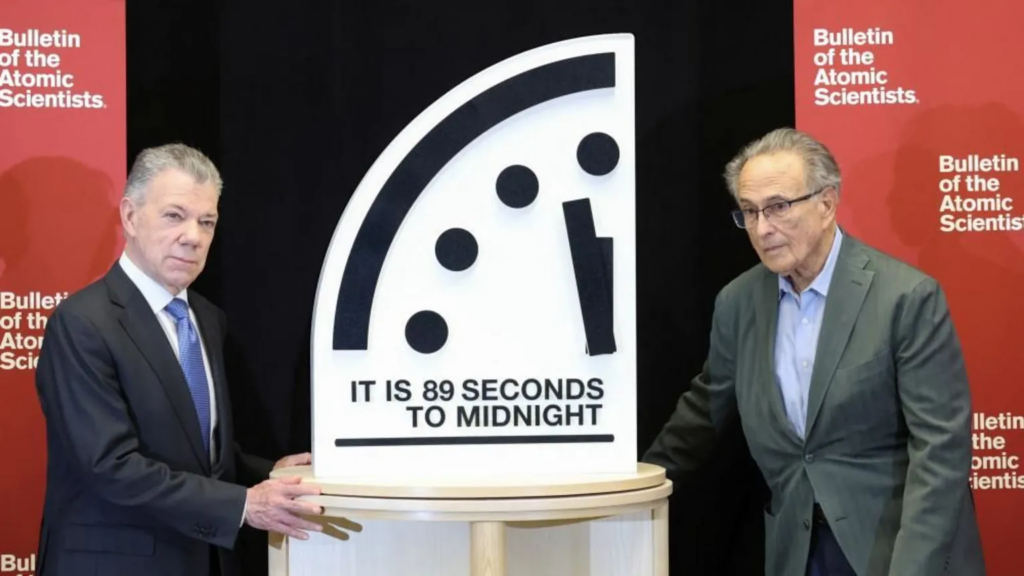
On Tuesday, scientists with the Bulletin of the Atomic Scientists moved the symbolic clock four seconds forward to 85 seconds to midnight. The clock was created in 1947 to represent how close the world is to global catastrophe. Midnight signifies disaster.
Each adjustment reflects the assessment of a panel of scientists and security experts on risks ranging from nuclear war to climate change, pandemics, artificial intelligence and geopolitical instability.
In its latest update, the Bulletin cited climate change as the most persistent and worsening driver of global risk. “Humanity continues to move in the wrong direction,” the group said in a statement, warning that global leaders have failed to act at the scale and speed needed to avert irreversible damage.
Scientists say rising greenhouse gas emissions and record-breaking temperatures are accelerating the climate emergency. The world has already warmed by more than 1.2°C above pre-industrial levels, and experts warn that breaching the 1.5°C threshold could trigger cascading environmental and social consequences.
Across the globe, the impacts are increasingly visible. In the Horn of Africa, prolonged drought has left millions facing water shortages and food insecurity. In low-lying Pacific islands, communities are being forced to relocate as sea levels rise. In Europe and North America, heatwaves, floods and wildfires are becoming more frequent and destructive, damaging infrastructure and overwhelming emergency services.
The Bulletin warned that despite repeated international pledges, global emissions continue to rise, fossil fuel investments remain high, and climate finance for vulnerable countries has fallen short of promises.
While climate change is the dominant factor, the Doomsday Clock’s latest shift also reflects rising nuclear dangers and geopolitical tensions. Several nuclear-armed states continue to modernize their arsenals, even as arms control agreements weaken. Experts warn that heightened tensions between major powers have increased the risk of miscalculation or accidental escalation.
“Today’s nuclear risks are as high as they were during the Cold War, if not higher,” the Bulletin noted, pointing to unresolved conflicts and deteriorating diplomatic relations.
The group also highlighted the rapid development of artificial intelligence and cyber capabilities as emerging threats, warning that weak governance and the spread of disinformation could destabilize democracies and amplify conflict.
Pandemics, too, remain a concern, with experts saying the world is still ill-prepared for future biological threats.
“These risks are not isolated,” the Bulletin said. “They interact and reinforce one another, creating a dangerous global environment.”
The Doomsday Clock serves as a visual metaphor for humanity’s proximity to existential danger. Originally focused on nuclear weapons, the clock now incorporates a broader range of threats, including climate change and disruptive technologies. The closer the clock’s hands are to midnight, the higher the perceived level of risk to human civilization.
When the clock moves closer to midnight, it signals that global conditions have become more dangerous. When it moves back, it reflects progress through international cooperation, arms reduction, technological safeguards or climate action.
Scientists and policy experts are calling for immediate, coordinated global action to slow climate change and reduce other existential risks. They are urging governments to accelerate the transition to renewable energy, protect forests and ecosystems, strengthen climate resilience, and meet their commitments under international climate agreements.
At the same time, they are calling for renewed arms control negotiations, stronger governance of emerging technologies, and greater investment in public health preparedness.
“The tools to reduce these risks already exist,” said one security analyst. “What’s missing is political will and sustained global cooperation.”