
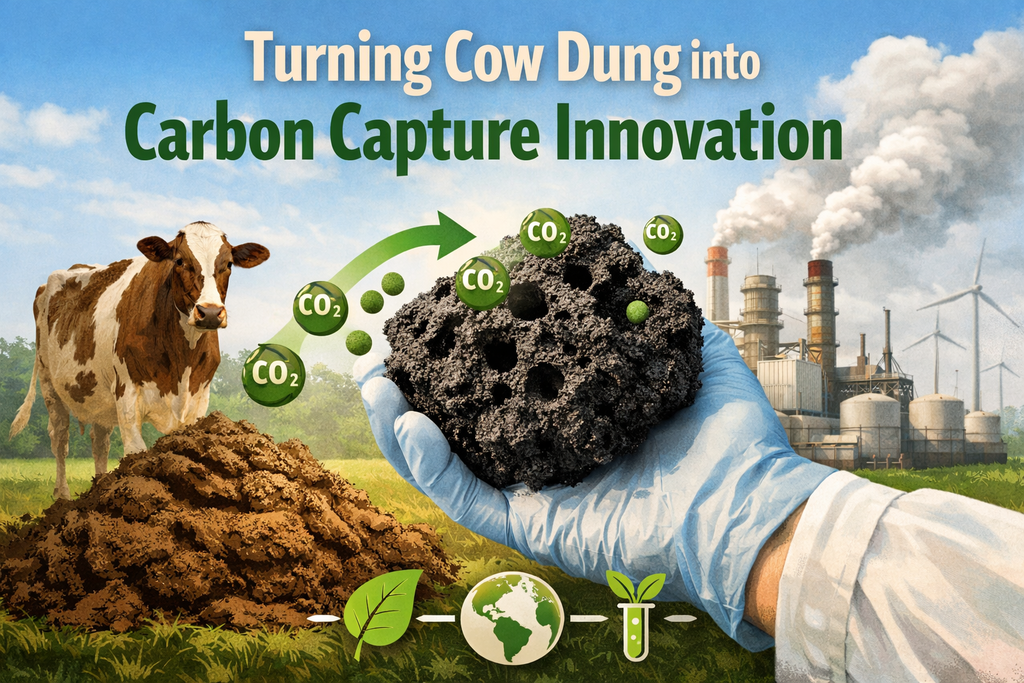

A new scientific breakthrough is transforming one of agriculture’s most overlooked waste products, cow dung, into a promising tool for tackling greenhouse gas emissions, offering a low-cost and sustainable pathway for carbon dioxide (CO₂) capture.
This is after researchers from the Indian Institute of Technology Gandhinagar (IITGN) developed a method of converting cow dung into a highly porous carbon material capable of trapping CO₂ before it enters the atmosphere, marking a significant innovation in the fight against climate change.
Carbon capture technologies, collectively known as carbon capture, utilisation and storage (CCUS), are increasingly seen as critical in reducing emissions from fossil fuels and industrial processes. However, existing methods often rely on expensive materials, energy-intensive processes, and chemicals that can themselves pose environmental risks.
The new approach sidesteps many of these challenges by using cow dung, an abundant agricultural waste, to create porous carbon adsorbent materials with microscopic pores that can trap CO₂ on their surface. Scientists say the material demonstrates strong performance, while also being cheaper and more environmentally friendly to produce.
Traditional carbon capture materials often involve toxic chemicals and generate wastewater during production. In contrast, the cow dung-based alternative minimizes chemical use and reduces environmental pollution during manufacturing.
The process is also described as scalable and stable over repeated use, raising the possibility of deployment in industrial settings where emissions are hardest to abate.
Livestock farming is typically associated with greenhouse gas emissions, particularly methane and nitrous oxide. But this research highlights a shift in thinking by seeing agricultural by-products not just as pollutants, but as part of the solution.
Already, cow manure is used in biogas systems to produce renewable energy, capturing methane that would otherwise escape into the atmosphere.
The development comes amid a broader global push to find new ways to capture and remove greenhouse gases, from ocean-based carbon removal to advanced materials and bio-based solutions.
While still in early stages, the cow dung-derived carbon material represents a shift toward nature-based and waste-driven climate technology solutions that are not only effective but also accessible and sustainable.