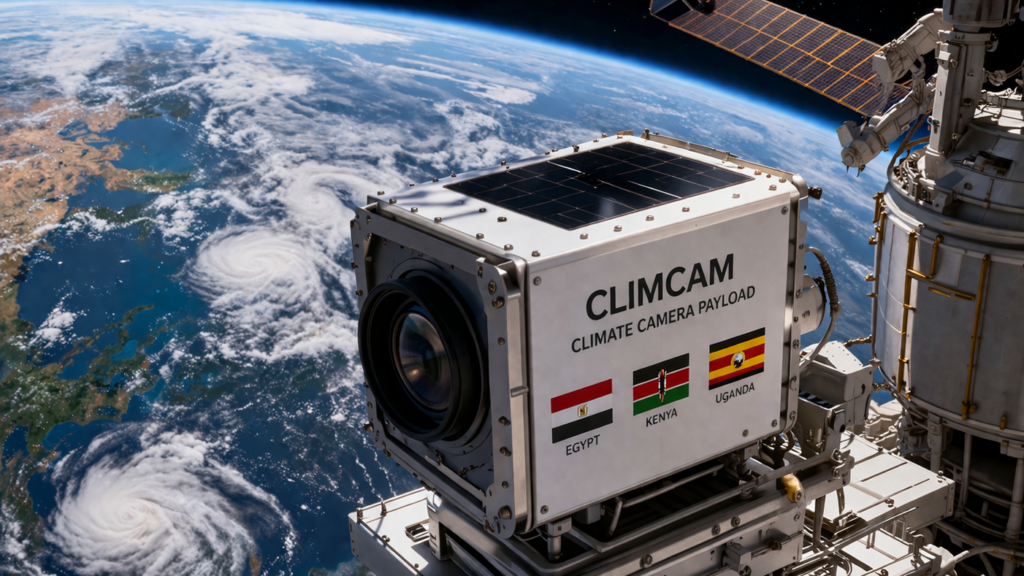

Africa has taken a significant step into space-based climate monitoring following the successful launch of the ClimCam (Climate Camera) mission, a joint initiative by Kenya, Egypt, and Uganda.
The mission lifted off on April 11, 2026, aboard the Cygnus NG-24 resupply spacecraft, which was launched by a SpaceX Falcon 9 rocket from Cape Canaveral, Florida. The spacecraft is currently en route to the International Space Station (ISS), where the climate-monitoring payload will be installed.
Officials involved in the project described the mission as a historic first for the continent, marking the first major tri-national space collaboration between the three African countries. The initiative brings together expertise from the Kenya Space Agency, the Egyptian Space Agency, and Ugandan partners in a coordinated effort to address climate challenges using space technology.
According to project stakeholders, the ClimCam payload is designed to deliver high-resolution imagery and data focused on environmental changes across Africa. Once operational aboard the ISS, the camera will monitor floods, droughts, and other climate-related hazards that continue to affect vulnerable communities across East and North Africa.

Scientists say the data generated by the mission will play a critical role in improving early warning systems and predicting extreme weather events. The information is also expected to support disaster preparedness efforts and strengthen food security planning in regions increasingly exposed to climate variability.
The launch underscores the growing technical capacity of African space agencies and highlights the importance of regional cooperation in tackling shared environmental challenges. Analysts note that locally driven space missions such as ClimCam could help bridge critical data gaps that have historically limited climate response strategies on the continent.
The Cygnus spacecraft is expected to dock with the ISS in the coming days. Once installation is complete, African engineers and scientists will begin receiving and analyzing the first images transmitted from the climate camera, offering a new, continent-focused perspective on Africa’s rapidly changing environment.