
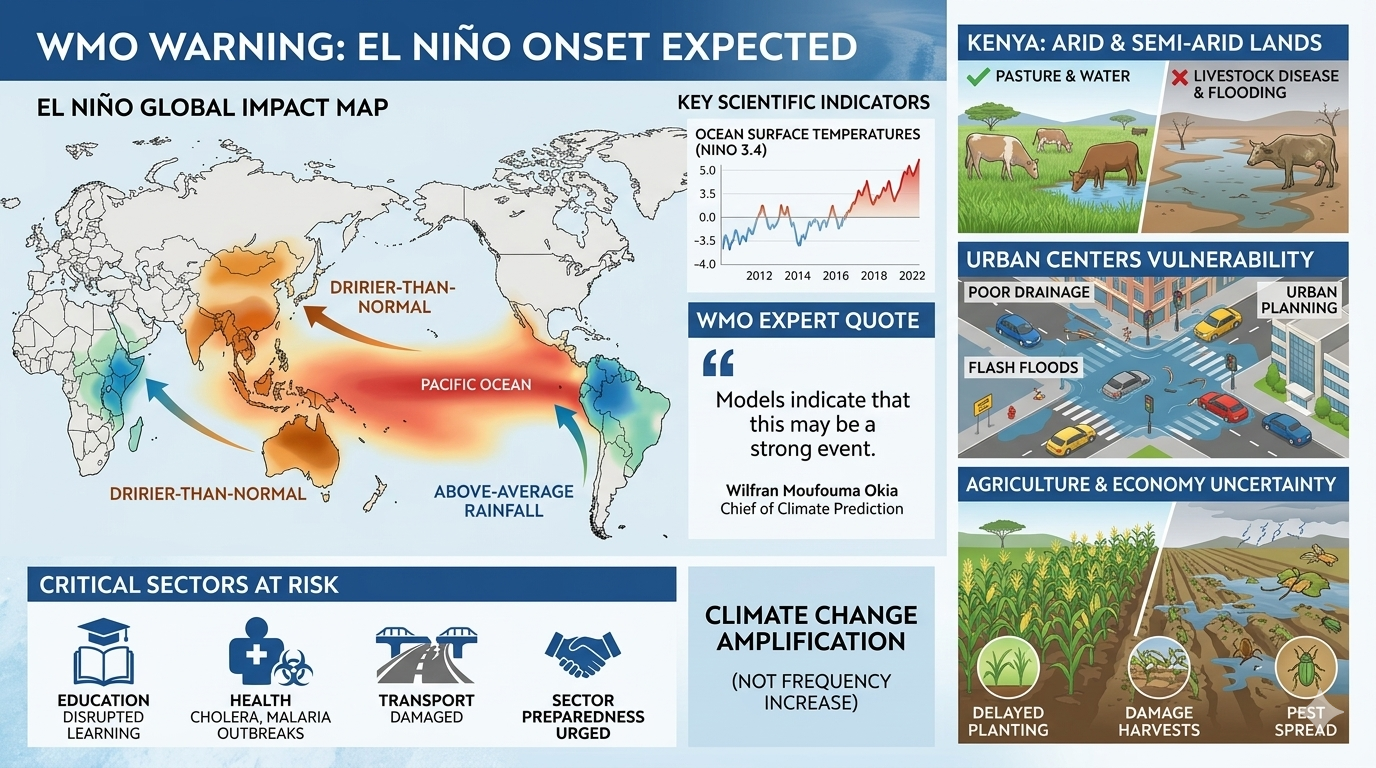
The World Meteorological Organisation (WMO) has warned of a possible El Niño onset between May and July this year, which could impact global temperature and rainfall patterns.
In its latest monthly Global Seasonal Climate Update, WMO says ocean surface temperatures in the equatorial Pacific are warming rapidly, which is a key indicator that El Niño conditions could soon develop.
“After a period of neutral conditions at the start of the year, climate models are now strongly aligned, and there is high confidence in the onset of El Niño, followed by further intensification in the months that follow,” said Wilfran Moufouma Okia, Chief of Climate Prediction at WMO. “Models indicate that this may be a strong event,” he added.
El Niño and La Niña are opposite phases of the El Niño–Southern Oscillation (ENSO), one of the most powerful climate patterns on Earth. These events reshape global weather, influencing rainfall, drought, and extreme events across regions. El Niño typically lasts between nine and 12 months.
According to the agency, the event is expected to influence temperature and rainfall patterns across large parts of the world. Some regions, including parts of the Horn of Africa, including Kenya, may experience above-average rainfall, while others, such as Australia, Indonesia and sections of Asia, could face drier-than-normal conditions.
Scientists also warn that El Niño can contribute to higher global temperatures, potentially amplifying the effects of human-induced climate change. In past events, the phenomenon has been linked to extreme weather, including floods, droughts and heatwaves.
WMO has urged governments and sectors such as agriculture, water management and disaster preparedness to closely monitor updates and prepare for potential impacts, noting that early warning systems remain critical in reducing risks to lives and livelihoods.
Historically, El Niño years have been associated with above-average rainfall, sometimes transforming parched landscapes into green expanses, but just often triggering floods that displace families, destroy crops and strain urban drainage systems.
“El Niño does not mean the same outcome everywhere, or even every time,” the WMO cautioned.
In Kenya’s arid and semi-arid lands, where pastoral communities depend on seasonal rains, an El Niño year can bring much-needed pasture and water, easing pressure built up over successive dry seasons. But the same rains, if intense and prolonged, can also lead to livestock disease outbreaks and flooding of grazing areas, undercutting those gains.
In urban centres, poor drainage infrastructure, encroachment on riparian land and rapid urbanisation have made cities increasingly vulnerable to flash floods, a pattern witnessed during past El Niño episodes.
Agriculture, the backbone of Kenya’s economy, sits at the centre of the uncertainty. While increased rainfall can boost crop yields in some regions, excessive moisture can delay planting, damage harvests and heighten the spread of pests and crop diseases.
The stakes are equally high for sectors such as education, health and transport, where extreme weather events often disrupt learning, increase disease outbreaks such as cholera and malaria, and damage roads and bridges.
According to WMO, there is no evidence that climate change increases the frequency or intensity of El Niño events, but it can amplify their associated impacts.