


By Yasir Faiz
In a quiet workspace in Addis Ababa, Ethiopia, Feven Tsehaye watches a bundle of wild-harvested herbs being sorted by hand after being air-dried to preserve their volatile oils. The result is a sensory alchemy of golden skincare oils that smell of earth and sun, and deep-hued herbal teas that carry the history of the Ethiopian highlands.
For Tsehaye, this is the meticulous preservation of nature, turning raw, indigenous plants into high-value products the world has long overlooked.
Tsehaye’s path to becoming a pioneer in Ethiopia’s emerging plant economy began far from the forest floor. Her background in social impact investing took her across the African continent, but it was the recurring gap between rural farmers and urban consumers that stayed with her.
“There was a shortage of products I wanted to use myself, things that are natural, free of chemicals, and transparent,” she recalls. But beneath that observation lay a concern about natural systems that were being undervalued, and with that undervaluation came their destruction.
In 2019, she founded Chaka Origin to challenge that pattern by not simply creating natural products but building a business model in which conservation itself becomes profitable, meaning that her business goes beyond oils and teas. It is a philosophy of development that begins not with clearing land, but with protecting it. For Tsehaye, the forest is not a barrier to economic growth; rather, it is the foundation of it.
At the core of her company is a model rooted in agroforestry, an approach that treats forests not as obstacles to agriculture, but as allies. In a world where development has often meant deforestation, Tsehaye’s work offers a radical alternative of building with nature, not against it.

Instead of clearing land for monoculture farming, Chaka Origin operates within existing forest ecosystems. Herbs, spices, and medicinal plants are carefully harvested from intact landscapes. The result is a system where economic activity does not erode biodiversity but reinforces it.
Ethiopia provides fertile ground for this vision. Its diverse ecosystems hold a wealth of indigenous plants, along with generations of knowledge about their uses. Yet much of that knowledge has been fading, squeezed out by global market pressures that favour standardization over diversity.
By identifying new, high-value applications for traditional plants through turning a local herb into a premium tea, or a medicinal oil into a global skincare ingredient, Tsehaye is restoring economic relevance to ecosystems that might otherwise be degraded or replaced.
But agroforestry is not only about plants. It is also about people, particularly women, who have long been the custodians of Ethiopia’s herbal knowledge.
“In many cases, herbs and spices are crops that women are already looking after,” Tsehaye says. Through structured buy-back agreements and annual contracts, Chaka Origin transforms this often-invisible labour into stable income. The forest remains intact, and communities gain a direct stake in its survival.
The environmental impact is both immediate and long-term. By avoiding deforestation, the model helps preserve biodiversity, protect soils, and maintain carbon sinks critical for climate regulation. Complementary practices such as Vermicomposting further restore soil health, turning organic waste into nutrient-rich compost and reducing reliance on chemical inputs.
“It’s really cool to see those kinds of changes,” Tsehaye says. “Ideally, these interventions become owned by the community.”
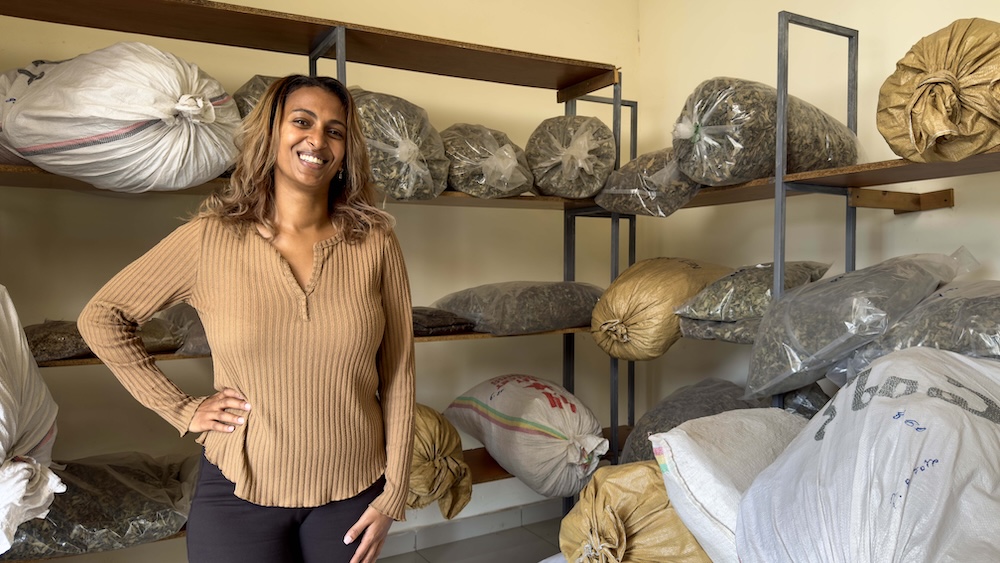
Climate change has only made this approach more urgent. Erratic rainfall, prolonged droughts, and shifting seasons threaten both ecosystems and livelihoods. In response, Chaka Origin invests in training farmers in climate-smart agroforestry, helping them adapt while maintaining ecological balance.
Inside Entoto Gallery, the results of this model are visible in the form of oils and teas that carry the scent of intact landscapes. Customers may come for quality, but what they are supporting is a value chain that rewards conservation.
Shop manager Edom Mersha notes that demand is strong, with products selling quickly, a sign that markets, when given the option, can align with sustainability.
Still, the model comes with constraints. Working within ecological limits means that scaling production is not straightforward. Forests can only provide so much without being compromised. For Tsehaye, this is the central tension on how to grow a business that depends on restraint.
Experts like Yonas Chebude highlight sourcing as a major challenge for Ethiopia’s natural products sector. But Chaka Origin’s strength lies in its traceability and relationships as every product is linked back to a specific ecosystem and community, creating a level of transparency that is increasingly valuable in global markets. “That’s a very good strategy,” Chebude observes.
What emerges from Tsehaye’s work is a redefinition of growth itself. Instead of expansion through extraction, it is growth through regeneration.
“We’re still exploring,” she says of future plans. “But the goal is to build something that’s good for the planet, farmers, and business.”
In an era defined by environmental crisis, the idea of f treating forests as allies rather than obstacles, may be one of the most important shifts of all.
Courtsey of bird story agency: https://agency.birdstoryagency.com/stories/bottling-ethiopia-s-green-gold?locale=en