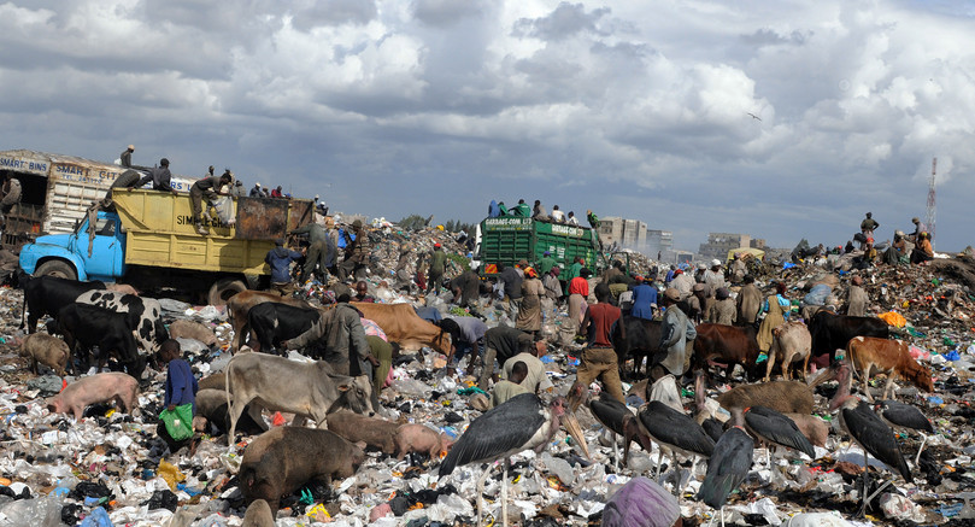

When I went looking for 54-year-old Stephen Njenga, I found his house locked. He had fallen behind on rent after cancer depleted his savings and left him unable to work. I eventually found him at a neighbour’s house, about 600 metres from Nairobi’s Dandora dumpsite. His own house is approximately 300 metres from the sprawling waste site.
Njenga has lived in Dandora for 20 years. He was diagnosed with lung cancer in February 2020, but his health problems began years earlier. “Around 2015, I started experiencing difficulty in breathing. My chest started aching and becoming congested,” he recalls.
A doctor advised him to stop smoking. Njenga, who had started smoking in 1990, had already quit around 2015.
He also describes repeated encounters with smoke and unpleasant fumes from the dumpsite. “I experience smoke and unpleasant fumes uncountable times,” he says.
Njenga’s smoking history is a recognised risk factor for lung cancer. However, neither his medical history nor this investigation can establish what caused his illness.
His experience raises a question that remains unanswered on whether prolonged exposure to smoke from burning rubbish increases the risk of lung cancer among people living around Dandora.
The former driver says he has been unable to return to work since becoming ill. He also describes losing family support after undergoing surgery, leaving him struggling with treatment costs and everyday living expenses.
His appeal to Nairobi City County and the National Environment Management Authority (NEMA) is to find alternatives to burning waste, particularly because he fears children and other residents are suffering in silence.
Dandora has received mixed waste for years, with burning rubbish exposing surrounding communities to smoke and fumes. Dr Joseph Mukundi, director of the Centre of Toxicology and Applied Research (CENTOX Kenya), says burning municipal waste, plastics, electronic waste, tyres and industrial materials can release harmful substances.
The smoke may contain tiny particles that penetrate deep into the lungs, as well as chemicals linked to cancer. The substances released depend on what is being burned and how it burns.
The World Health Organization’s 2025 publication, Open Waste Burning: Sectoral Solutions for Air Pollution and Health, identifies open waste burning as a source of harmful air pollution and calls for measures to reduce the practice.
Research has also documented contamination around Dandora. A 2010 University of Nairobi study found higher levels of certain pollutants in air and soil samples from Dandora and Industrial Area than in Kabete. A separate study published in 2020 detected lead, cadmium and chromium in soil samples from eight locations at the dumpsite, concluding that the soil was heavily polluted with the metals examined.
An earlier investigation by the International POPs Elimination Network, ENVILEAD and Arnika Association found elevated levels of dioxins and other harmful chemicals in free-range chicken eggs collected near Dandora. The 2005 report recorded dioxin levels almost 18 times higher than background levels.
More recent air-quality measurements point to continuing concerns. The Kenya Meteorological Department’s State of the Climate in Kenya 2025 report recorded annual average levels of fine particulate matter at its Dandora Phase Four monitoring site of 28.1 micrograms per cubic metre in 2024 and 30.5 micrograms in 2025.
The 2025 level was about six times the WHO’s recommended annual limit of five micrograms per cubic metre, and was also the highest among the 11 Nairobi monitoring locations included in the report.
Dr George Mwaniki, World Resources Institute Africa’s head of air quality, says the readings indicate a significant air-quality problem, although they cannot establish how much of the pollution comes from the dumpsite.
Wind, rainfall and other weather conditions influence where pollution travels and how long it remains in the air and residents living farther from the dumpsite may still be exposed, depending on wind direction and other conditions. Determining what residents are breathing would require monitoring at different locations, supported by analysis of the pollutants and weather conditions.
The link between outdoor air pollution and lung cancer is established. In 2013, the International Agency for Research on Cancer, a specialised cancer agency of the WHO, classified outdoor air pollution and particulate matter in outdoor air as carcinogenic to humans.
Consultant pulmonologist Dr Joseph Aluoch says prolonged exposure to polluted air can cause or worsen respiratory conditions such as asthma and chronic obstructive pulmonary disease, while long-term exposure to fine particles can also increase lung cancer risk.
However, establishing whether people living around Dandora face a higher risk requires more than documenting pollution or respiratory complaints. Dr Victor Oria, principal research scientist at the Victoria Biomedical Research Institute in Kisumu, says researchers would need to follow people over time and examine how frequently and for how long they are exposed.
They would also need to account for other risk factors, including smoking and exposure to harmful substances at work.
For Judy Wanyoike, a community health promoter in Dandora, respiratory complaints are a recurring concern. She says residents frequently report persistent coughing, chest pain and breathing difficulties. Those living closest to the dumpsite appear to experience more problems, she observes.
Dr Mukundi says a comprehensive investigation should combine air-quality monitoring with research into residents’ health. Researchers would need to measure pollution during burning events, examine the harmful substances in the smoke and establish how long residents have lived or worked near the dumpsite.
Dr Mwaniki recommends monitoring the dumpsite and surrounding residential areas, including locations both upwind and downwind. Measurements should cover different seasons and be supported by records of burning events.
Such evidence would help distinguish pollution from the dumpsite from other sources and establish how much residents are exposed to.
For Njenga, the consequences of lung cancer are already clear as he remains unable to work and struggles with the cost of treatment and everyday living. His smoking history is a recognised risk factor. But his two decades of residence near the dumpsite and repeated encounters with smoke raise questions that his medical history alone cannot answer.