

As the sun dips below the horizon, casting a golden glow over Africa’s majestic Mt. Kilimanjaro, darkness sweeps across the plains of Kimana in Kajiado County.
In the chilly night, a patrol team from Big Life Foundation races through villages, their truck’s powerful spotlights slicing through the gloom. They have received an urgent call about elephants that have invaded a local farm, threatening crops, lives and livelihoods.
Nestled at the foothills of Kilimanjaro, Kimana’s farmers face a relentless challenge as elephants, drawn from nearby Amboseli National Park and surrounding conservancies, frequently trample through fields, leaving devastation in their wake.
“Earlier this year, four elephants destroyed half an acre of my maize crop,” says Joel Mulinga, a farmer in Kimana. “Help came from Big Life Foundation that stopped further destruction.”
For years, farmers like Joel have battled these gentle giants, their hard-earned harvests reduced to rubble in hours.
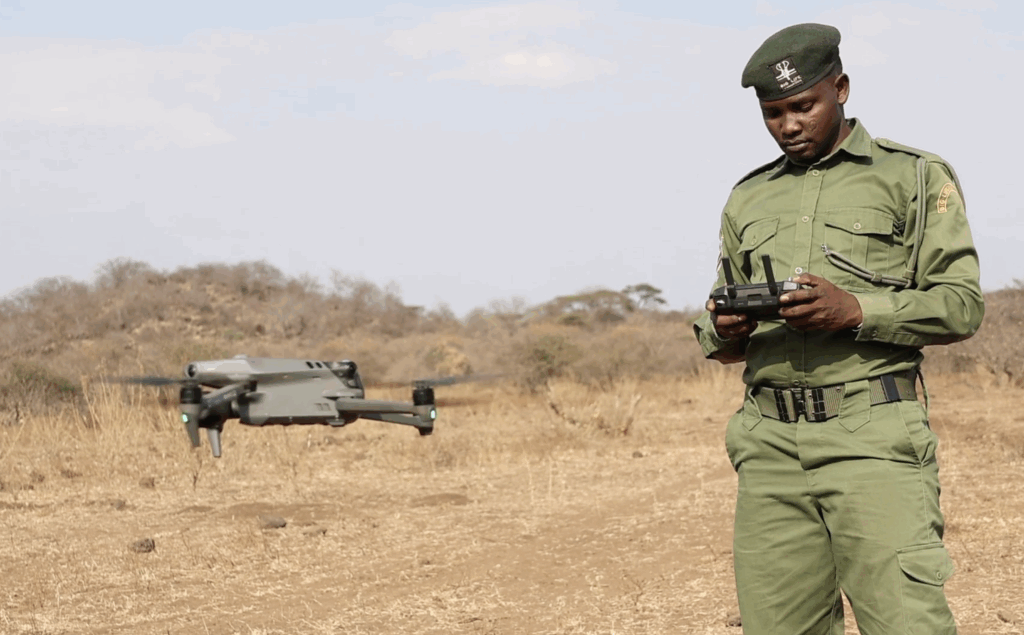
But hope is rising in Kimana, thanks to an innovative initiative by Big Life Foundation that is using drones equipped with cameras and lights, capable of operating day or night. These high-tech sentinels are transforming the fight against human-wildlife conflict, offering a safer, more effective way to protect both farmers and elephants.

A game-changer in the night sky
On this night, the drone team springs into action. High above the farm, their drone buzzes to life, its lights pinpointing the elephants’ location with precision.
“The drone’s noise irritates the elephants, driving them away from the crops,” explains David Ntinina, a ranger and drone operator with Big Life Foundation. “Before, we had to chase them on foot, putting ourselves in danger. Now, we can manage from a safe distance.”
Electric fences, once a go-to solution, are no longer enough. Elephants, intelligent and adaptable, have learned to bypass them.
Since the program began, farmers have reported fewer invasions, allowing them to sleep soundly instead of standing guard with flashlights.
Joel is optimistic. “We’re seeing a difference,” he says. “I hope to harvest my tomatoes this season.” For a community long plagued by crop losses, this is no small victory.
A fragile balance in the Amboseli ecosystem
The Amboseli ecosystem, spanning Amboseli National Park and surrounding areas like Kimana Wildlife Sanctuary, is home to an estimated 1,600 to 2,000 elephants, according to the Amboseli Trust for Elephants and Big Life Foundation. These elephants roam vast distances in search of water and pasture, often wandering into human settlements. With such a large population, conflict is inevitable.
Big Life’s drone program, though limited to just two units, is a lifeline for Kimana’s farmers. “Two drones are not enough to cover this vast area, but it is better than nothing,” says Abraham Ngao, a radio room operator at Big Life’s headquarters.

The drones’ effectiveness, nearly 100% so far, has sparked hope, but questions linger. Will elephants eventually grow accustomed to the drones’ buzzing? “We’re monitoring trends to stay ahead,” Ngao says. “For now, this technology is working.”
As the patrol team wraps up their mission, the elephants retreat, and the farm is safe for another night. The chilly wind from Kilimanjaro still bites, but for Kimana’s farmers, the future feels warmer.
In Kimana, the battle between man and elephant is far from over, but with drones lighting the way, a fragile harmony is taking root. For farmers like Joel, it is a chance to reclaim their fields and their peace of mind.