

By Peter Owino
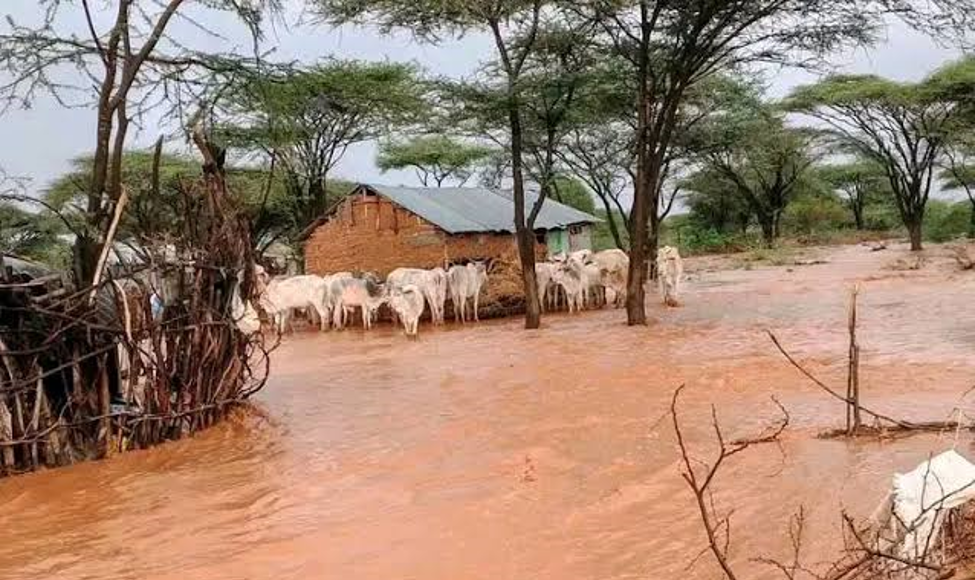
Heavy rains have triggered flooding across several parts of Kenya, killing at least one person, destroying homes and livestock, submerging farms and cutting off major roads, as the Kenya Meteorological Department warns of continued rainfall in 37 counties this week.
A 21-year-old man was swept away by River Tyaa near Mwingi town in Kitui County on November 16 while helping a woman cross the flooded river. The woman survived, but the man was struck by a floating log and carried downstream. His body was later recovered about 10 kilometers from where he was swept away.
The incident occurred as flash floods cut off the Nairobi–Garissa Highway at Mwambuni and Mbakini in Mwingi, leaving hundreds of travellers stranded on either side of the flooded crossings.
The KMD’s weekly forecast, issued on November 16, identifies 37 counties expected to receive rainfall during the period, raising the prospect of further flash floods, waterlogging, soil erosion and transport disruptions.
In Kitui, flooding at the Mbakini River crossing disrupted one of the main transport links between Nairobi and north-eastern Kenya as buses, matatus, lorries and private vehicles were stranded as fast-moving water submerged the crossing.
At Mwambuni, also in Mwingi, floodwaters swept away part of the highway, further disrupting movement between Nairobi, Mwingi and Garissa and the transportation of goods along the corridor.
In Taita Taveta County, Voi town also experienced heavy flooding that affected normal activities following heavy rainfall.
The flooding has also affected communities in Tana River County, where more than 300 households were affected after a seasonal river at Wardesa burst its banks, flooding settlements in Eldera, Kono Ramadha and Mata Wardesa. The Kono Ramadha–Mlanjo road was cut off, disrupting movement and access to affected communities.
More than 200 livestock were also reportedly swept away by floodwaters in the affected areas, dealing a significant blow to pastoral households whose livelihoods depend on livestock. In Kote village, residents were left counting their losses after overnight flooding swept through homesteads and livestock enclosures.
In Turkana County, flash floods destroyed more than 100 houses, leaving families homeless and disrupting transport in several areas.
The destruction is also spreading across the Rift Valley and western Kenya. In Elgeyo Marakwet County, the Embobut River burst its banks, flooding the Soko Bora area and making the road and bridge impassable. Commuters travelling between Kapsowar and Eldoret were stranded as floodwaters swept across the crossing.
In West Pokot, heavy rainfall destroyed homes, submerged farms and damaged roads. A footbridge linking Arol and Tandapos in Adurkoit was swept away, disrupting movement between the two areas. Several households in Riwo and Suam wards also reportedly lost goats, sheep and farm produce.
Trans Nzoia experienced flooding around Soko Mjinga shopping centre, while heavy rainfall was also reported in Baragoi, Samburu County.
The unfolding floods come amid an El Niño event expected to influence the current rainy season, with forecasts indicating further intensification towards the end of the year.
In its October 21 global seasonal update, the World Meteorological Organisation (WMO) projected further intensification of El Niño during November 2026–January 2027, with warming in the central and eastern tropical Pacific expected to peak around December.
The organisation said the event was likely to persist into early 2027, increasing the potential for extreme weather in different parts of the world.
El Niño is a natural climate phenomenon associated with the periodic warming of surface waters in the central and eastern equatorial Pacific Ocean. It influences atmospheric circulation and alters rainfall patterns in different parts of the world.
In East Africa, El Niño conditions are commonly associated with enhanced rainfall during the October–December short-rains season, increasing the potential for floods, landslides and disruption of livelihoods.
The government has previously warned that up to 1.5 million people could be affected by floods, landslides and other hazards during the 2026 rainy season, including an estimated 500,000 people who could be displaced by flooding.
The latest incidents are raising questions about the preparedness of national and county governments to manage the humanitarian and economic consequences of an extended period of heavy rainfall.
Residents have been advised to avoid crossing flooded roads and swollen rivers, keep children away from drainage channels and move to safer ground where flooding threatens their homes. Farmers and pastoralists have also been urged to protect livestock, secure farm inputs and harvested produce, and avoid dangerous river crossings.