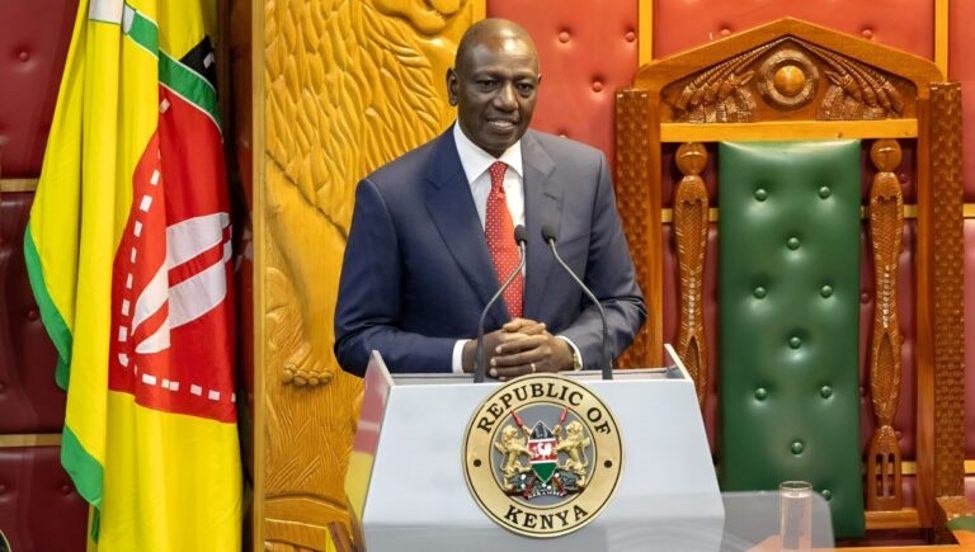

President William Ruto has left climate change, environmental conservation and adaptation out of his development agenda, despite outlining major investments in energy, water, agriculture and infrastructure that are increasingly threatened by the climate crisis.
In his State of the Nation address to Parliament on November 18, the President announced plans to expand electricity generation, construct dams, increase irrigated agriculture and strengthen pastoral economies. Yet his development priorities offered little indication of how the government intends to protect these investments against climate risks or safeguard the natural ecosystems on which they depend.
Though some of the proposed investments spelt by the president could support climate resilience and the transition to a low-carbon economy, they were presented primarily as economic growth and production measures rather than components of a coordinated national climate response.
The gap is significant because the sectors at the centre of President Ruto’s economic agenda are among the most exposed to climate change as increasingly destructive floods, prolonged droughts, rising temperatures and unpredictable rainfall disrupt agricultural production, threaten water security, damage infrastructure and undermine livelihoods.
On energy, President Ruto said the government would mobilise investment to generate an additional 10,000 megawatts of electricity from geothermal, hydro, wind and solar resources. The expansion is intended to meet rising electricity demand, support industrialisation and improve the country’s economic competitiveness.
Its success, however, will depend on climate-resilient energy infrastructure and the protection of natural resources, particularly water catchments that sustain hydropower generation, issues that the President did not address.
On water security, the President announced plans to construct at least 50 mega dams, 200 medium and small dams, and thousands of water-harvesting structures. The projects are intended to increase water availability for households, industry and agriculture, supporting the government’s ambition to reduce dependence on rain-fed farming. The government also intends to bring at least 2.5 million acres under irrigation.
Delivering this ambition will require sustainable water supply, protection of catchments and restoration of degraded ecosystems as changing rainfall patterns place additional pressure on water resources.
The same challenge applies to pastoral economies, where climate change is intensifying pressure on livestock production and livelihoods. The Head of State cited the De-risking, Inclusion and Value Enhancement of Pastoral Economies (DRIVE) programme, saying more than 245,000 pastoralists had accessed livestock insurance and savings incentives, protecting over 3.3 million animals.
The programme provides financial protection against drought-related livestock losses, but insurance alone cannot address the wider challenges facing pastoral communities, including recurrent drought, deteriorating rangelands and increasingly unpredictable weather.
The scale of climate threat to economic growth is reflected in government assessments of climate-related economic losses. The National Treasury’s Disaster Risk Financing Strategy 2026–2030 identifies climate-related disasters as a growing threat to economic stability and public finances. It estimates that floods during the October–December 2023 and March–May 2024 rainy seasons caused damages and losses amounting to KSh187.82 billion.
Agriculture and other climate-sensitive sectors remain particularly exposed, with disruptions affecting food production, employment, household incomes and economic growth.
The Kenya Meteorological Department’s State of the Climate Report 2025 also documents a warming trend, alongside increasingly disruptive weather events with implications for agriculture, water resources and human settlements.
Kenya already has a policy framework for responding to these threats, including the Climate Change Act, successive National Climate Change Action Plans and commitments under the Paris Agreement to reduce greenhouse gas emissions and strengthen adaptation. However, the President’s address did not provide an account of progress in implementing these commitments, mobilising climate finance, advancing locally led adaptation or protecting ecosystems that sustain water supplies and livelihoods.
Forest conservation and the protection of wetlands also received no attention, despite continuing pressure on the country’s natural ecosystems from deforestation, illegal logging, land grabbing and encroachment into protected forest areas. These threats are undermining critical water catchments, accelerating biodiversity loss and weakening the ecosystems that support agriculture, water supplies and livelihoods.
The absence of conservation and ecosystem restoration from the development priorities raises questions about how the government intends to reconcile its expansion ambitions with the protection of the natural resources on which long-term economic growth depends.
What emerged from the address is that President Ruto’s development agenda places considerable emphasis on expanding Kenya’s productive capacity, but gives insufficient attention to the climate and environmental safeguards needed to protect those investments.
With climate extremes already imposing substantial economic losses, the country’s development challenge should go beyond how to build more infrastructure, produce more food or generate more electricity, to address how to ensure those gains survive a changing climate.