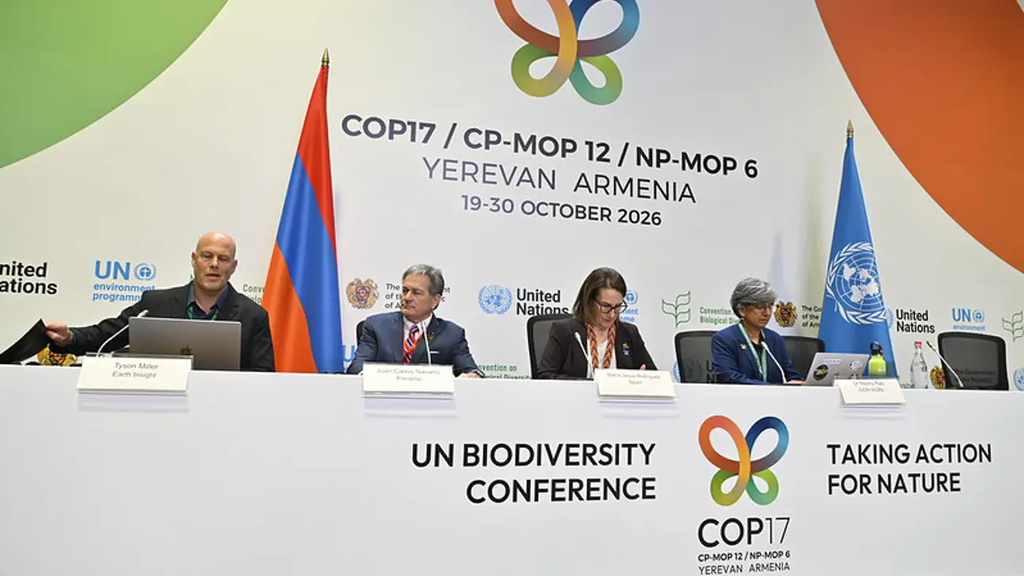

Governments have adopted a new implementation pathway to speed up efforts to halt biodiversity loss by 2030, but disagreements over who should finance conservation leave African countries facing uncertainty over the resources needed to protect their natural heritage.
This was reached during the 12 days of negotiations at the 17th Conference of the Parties to the Convention on Biological Diversity (CBD COP17) in Yerevan, Armenia.
The negotiations produced approximately 50 decisions, including an agreement known as the Yerevan Pathway, which sets out priorities for accelerating implementation of the Kunming-Montreal Global Biodiversity Framework (GBF) between now and 2030.
For African countries, which hold some of the world’s most important biodiversity resources but face significant financial and institutional constraints in protecting them, the outcome carries implications for conservation financing, community rights, sustainable land management and access to benefits from biological resources.
The agreement comes amid growing concerns that the world is falling behind on commitments made in 2022 to halt and reverse biodiversity loss by the end of the decade.
The first global assessment of progress under the framework, presented ahead of COP17, found that although nearly 90 per cent of countries had established national biodiversity targets, fewer than half of those assessed were on track to meet them. The assessment also highlighted inadequate financing, weak implementation and limited integration of biodiversity considerations into national economic planning as major obstacles to achieving the 2030 targets.
One of the most consequential issues for African countries was the failure to secure a clear, predictable financing arrangement. Under the Kunming-Montreal framework, countries agreed to mobilise at least $200 billion annually from all sources by 2030, including increasing international biodiversity financing for developing countries to at least $30 billion annually by 2030. However, developed countries failed to meet the earlier commitment to mobilise at least $20 billion annually by 2025.
The financing dispute at COP17 centred partly on proposals by developed countries to broaden the pool of international contributors to include emerging economies such as China, India and other financially capable developing countries. Developing countries opposed making this a new obligation, arguing that industrialised nations should first honour their existing financial responsibilities.
For Africa, the financing question is particularly important because biodiversity conservation competes with other development priorities, including infrastructure, healthcare, education and food security. Insufficient financing also threatens efforts to restore degraded landscapes, protect endangered species and strengthen the resilience of communities whose livelihoods depend on natural resources.
Another significant outcome for Africa was the agreement on the operating arrangements of the permanent subsidiary body dealing with Indigenous Peoples and local communities under Article 8(j) of the Convention. The body, established at COP16 in Colombia in 2024, provides a formal platform for advancing the participation and recognition of Indigenous knowledge in biodiversity conservation.
The eventual adoption of the arrangements, referred to as the Sevan Guidelines, provides an institutional basis for strengthening the participation of Indigenous Peoples and local communities in global biodiversity governance. The decision has particular relevance for Africa, where communities depend on forests, rangelands, wetlands and other ecosystems for food, water, medicine and livelihoods.
Governments also agreed to accelerate action towards reforming environmentally harmful subsidies and incentives, a development with implications for African economies heavily dependent on agriculture, fisheries, forestry and other natural-resource-based sectors.
Under Target 18 of the Kunming-Montreal framework, countries committed to identifying and eliminating, phasing out or reforming incentives harmful to biodiversity, with the aim of reducing them by at least $500 billion annually by 2030.
The Armenian presidency also launched initiatives to encourage governments to redirect financial incentives towards activities that support biodiversity. For African countries, the issue raises questions about how public spending, agricultural subsidies, infrastructure investment and natural-resource exploitation can be aligned with conservation objectives without undermining food security and livelihoods.
The negotiations also addressed benefit-sharing from the commercial use of digital sequence information (DSI) on genetic resources. The issue is important to biodiversity-rich African countries whose plants, animals and microorganisms provide genetic material used in pharmaceuticals, biotechnology, agriculture and cosmetics.
The Cali Fund, established following COP16, is intended to ensure that companies benefiting commercially from genetic information contribute towards conservation and benefit-sharing. Under the mechanism, companies in relevant sectors are encouraged to contribute indicative amounts equivalent to one per cent of profits or 0.1 per cent of revenue. At least half of the fund’s resources are intended to support Indigenous Peoples and local communities.
However, the mechanism has struggled to attract contributions from major companies. Reporting during COP17 indicated that deposits stood at just $8,990 as of October 26, highlighting the gap between the benefit-sharing agreement and actual financial returns.
Beyond the formal negotiations, African institutions used the conference to advance financing initiatives aimed at supporting conservation and nature-positive investment. The African Development Bank highlighted the need to mobilise investment for implementing the Kunming-Montreal framework across the continent, including through stronger policy coordination and collaboration with development finance institutions.
The Yerevan agreements leave governments with four years to demonstrate measurable progress towards the 2030 biodiversity targets. The Kunming-Montreal framework includes commitments to conserve at least 30 per cent of the world’s land and inland waters, as well as marine and coastal areas, and restore at least 30 per cent of degraded ecosystems.
Yet the global review presented at COP17 found that protected and conserved areas covered approximately 19 per cent of land and inland waters and 10 per cent of marine areas, leaving substantial ground to cover. The review also identified shortcomings in pollution control, ecosystem restoration, biodiversity monitoring and the integration of conservation into economic planning.
The Yerevan Pathway seeks to address these gaps through stronger national biodiversity strategies, improved monitoring, increased financing and greater coordination across government institutions.
The next major opportunity to assess progress will be COP18, scheduled for 2028 in Quito, Ecuador.