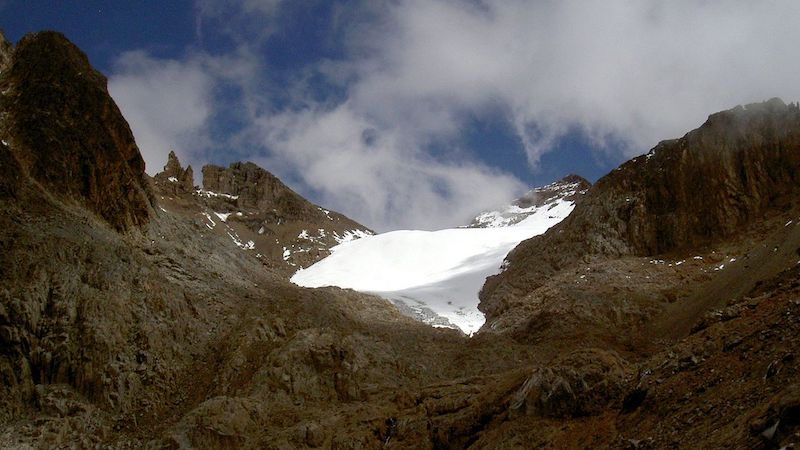

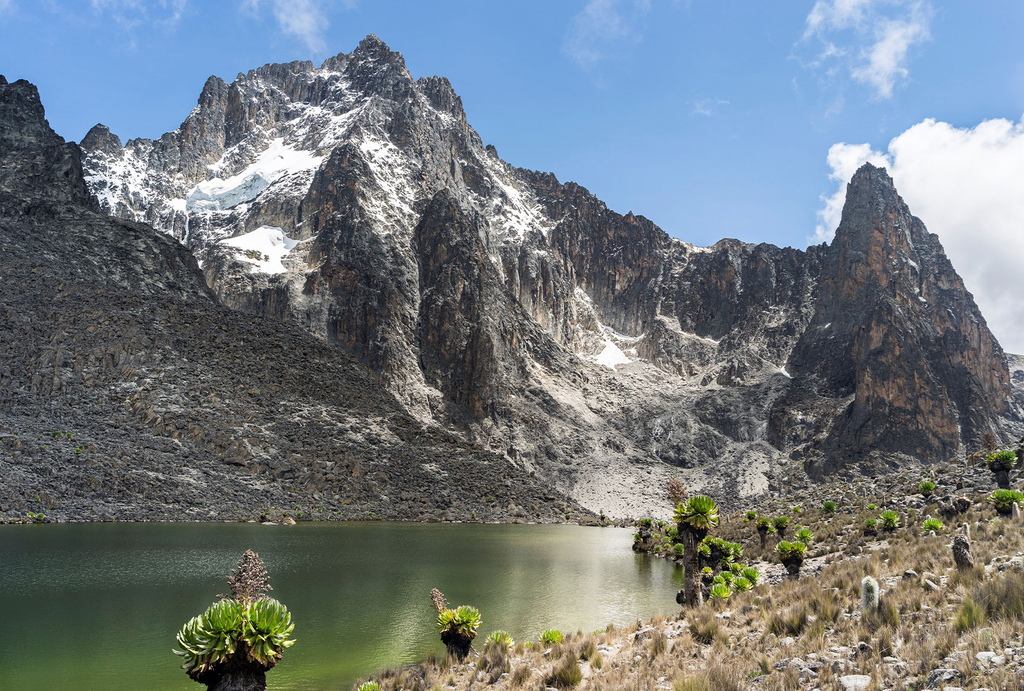
Mount Kenya has lost nearly 96 per cent of its glacier area since the beginning of the twentieth century, leaving the Kenya’s highest mountain with only scattered patches of ice that scientists expect to disappear by 2030.
The World Meteorological Organization’s State of the Climate in Africa 2025 report shows that glacier cover on Mount Kenya declined from 1.64 square kilometres in 1906 to just 0.07 square kilometres in 2021/2022.
The decline is the most severe by proportion among Africa’s three surviving glacier systems. The others are on Mount Kilimanjaro in Tanzania and the Rwenzori Mountains along the Uganda –Democratic Republic of the Congo border.
Together, the three mountains have lost more than 90 per cent of their glacier area since the late nineteenth century, according to WMO. Kilimanjaro’s ice shrank from 11.4 square kilometres in 1900 to about 0.98 square kilometres in recent years. In the Rwenzori Mountains, glacier cover fell from 6.51 square kilometres in 1906 to 0.38 square kilometres by 2021/2022, meaning that Mount Kenya now has the smallest surviving glacier area of the three.
The retreat is visible on Lewis Glacier, historically the mountain’s largest and most closely studied ice body. Research published in the journal Geosciences found that Lewis Glacier lost 46 per cent of its surface area and 57 per cent of its volume between 2004 and 2016.
Its deterioration accelerated after 2010 as thinning ice exposed a rock outcrop that split the glacier into separate sections. Smaller and disconnected ice patches have more edges exposed to sunlight, warmer air and heated rock, making them more vulnerable than a continuous glacier.
Climate change is creating the conditions driving this retreat, although the process is more complicated than warm air simply melting the ice. A glacier survives when snow accumulating on its surface is sufficient to replace ice lost through melting, sublimation and other processes.
A study of Lewis Glacier published in The Cryosphere found that the glacier is receiving insufficient snowfall while experiencing enhanced ice loss. Its condition is particularly sensitive to atmospheric moisture, which controls snowfall, cloud formation and the amount of sunlight absorbed by the surface.
Rising temperatures intensify the problem by lifting the atmospheric freezing level, increasing melting and causing some precipitation to fall as rain instead of snow. Mount Kenya and the Rwenzori glaciers lie close to the regional freezing level, making them particularly sensitive to relatively small temperature changes.
Kilimanjaro is different because much of its ice lies well above the average freezing level. Research indicates that reduced atmospheric moisture and snowfall, followed by radiation-driven ice loss, have played especially important roles there.
In the Rwenzori Mountains, scientists have identified rising temperatures, reduced cloud cover and increased solar radiation as interacting causes.
These local processes are unfolding within a wider warming trend. WMO reports that Africa has been warming faster than the global average and that its warming rate since 1991 has been substantially higher than during preceding 30-year periods. Africa’s average land temperature in 2025 was approximately 0.51°C above the 1991–2020 average.
Mount Kenya feeds tributaries of the Tana and Ewaso Ng’iro systems, including the Naro Moru, Nanyuki, Burguret, Likii, Kathita, Nyamindi, Thiba and Sagana rivers. These waters support homes, farms, wildlife, irrigation and electricity generation.
However, the major rivers are not sustained principally by the remaining glaciers. Rainfall, montane forests, high-altitude wetlands, soils and groundwater provide most downstream flow. Water captured by the mountain’s forests and moorlands infiltrates the ground and is gradually released through springs and rivers.
Evidence from the Rwenzori Mountains demonstrates the limited contribution of the surviving ice to large rivers. Field measurements found that glacier melt accounted for considerably less than two per cent of river discharge at the base of the mountains during both wet and dry periods.
Mount Kenya’s glaciers may still influence small headwater streams and high-altitude lakes and their disappearance could change water temperature, seasonal flow, sediment and water chemistry near the summit, affecting aquatic organisms adapted to cold conditions. But declining downstream river flows cannot credibly be attributed to glacier loss alone. Rainfall variability, forest degradation, groundwater changes and increasing human abstraction are likely to have much larger effects.
The environmental loss extends beyond river volumes. Retreating ice exposes unstable rock and debris, potentially increasing local rockfalls and slope failure. Alpine plants and animals confined to cold environments face shrinking habitats, while glacier-fed tarns and streams may undergo permanent ecological changes.
Economically, the disappearance threatens an important element of East Africa’s tourism identity. The ice-capped peaks of Mount Kenya, Kilimanjaro and the Rwenzori draw climbers, hikers and researchers from around the world. Vanishing ice will alter scenery, climbing conditions and some established routes, although no reliable assessment has quantified the tourism revenue specifically attributable to the glaciers.
Mount Kenya is also a national park, biosphere reserve and UNESCO World Heritage Site. Its glaciers form part of the landscape’s scientific, cultural and spiritual significance, particularly for communities that regard the mountain as sacred.