
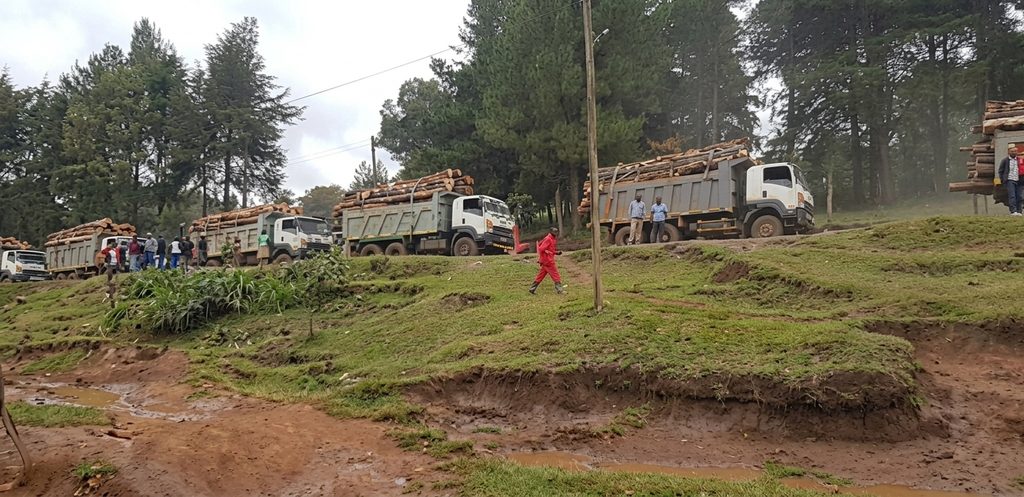

The Kenya Forest Service (KFS) has defended commercial tree harvesting in public forest plantations amid growing public concern over massive cutting of trees in Aberdare ranges and Kereita Forest.
The agency issued the statement after the circulation of videos showing convoys of lorries carrying timber from forested areas, prompting Kenyans to question whether logging operations are compatible with the government’s conservation commitments.
The controversy has emerged as the government intensifies its campaign to grow 15 billion trees by 2032, raising questions about how the country can expand tree cover while protecting existing forests, biodiversity and water catchments.
According to KFS, Kenya’s forest estate covers approximately 2.602 million hectares, of which 152,790.1 hectares are industrial plantation forests managed for commercial timber production. The agency says the remaining forest estate comprises indigenous and natural forests, alongside dryland woodlands.
The agency says public plantation forests are managed under approved Plantation Forest Management Plans, with harvesting subject to environmental assessments, licensing and supervision by forestry officials.
KFS identifies cypress, pine and eucalyptus among the principal commercial plantation species, arguing that harvesting mature plantation trees is part of a managed production cycle rather than necessarily an act of deforestation.
It says delaying harvesting beyond maturity can result in decay, increased fire risk and commercial losses, while preventing land from being prepared for the next planting cycle.
In Nyandarua County, residents and local leaders have raised concerns about the volume of timber being transported from the Aberdare Forest ecosystem, warning that extensive harvesting could affect water sources and undermine conservation efforts.
Residents said the scale of the activity had caused alarm, while local leaders called for greater public involvement in decisions affecting the forest.
Nyandarua Governor Kiarie Badilisha raised concerns about water supplies, saying some small streams at water intake points he had visited had dried up.
Kipipiri MP Wanjiku Muhia also questioned the scope and duration of the lifting of the logging ban and said she had raised the matter in Parliament.
Responding to the concerns, Nyandarua County Forest Conservator Daniel Mkung said 50 sawmillers had been authorised to harvest mature and over-mature trees in designated plantations.
The Rift Valley, Central and Eastern Association of Sawmillers also defended the exercise, arguing that harvesting mature plantation trees generates revenue, supplies timber to local markets and allows the next planting cycle to begin.
Logging has also been reported in Kereita Forest, prompting concerns about whether the trees being removed were part of authorised commercial plantations or whether harvesting was affecting ecologically sensitive natural forest areas.