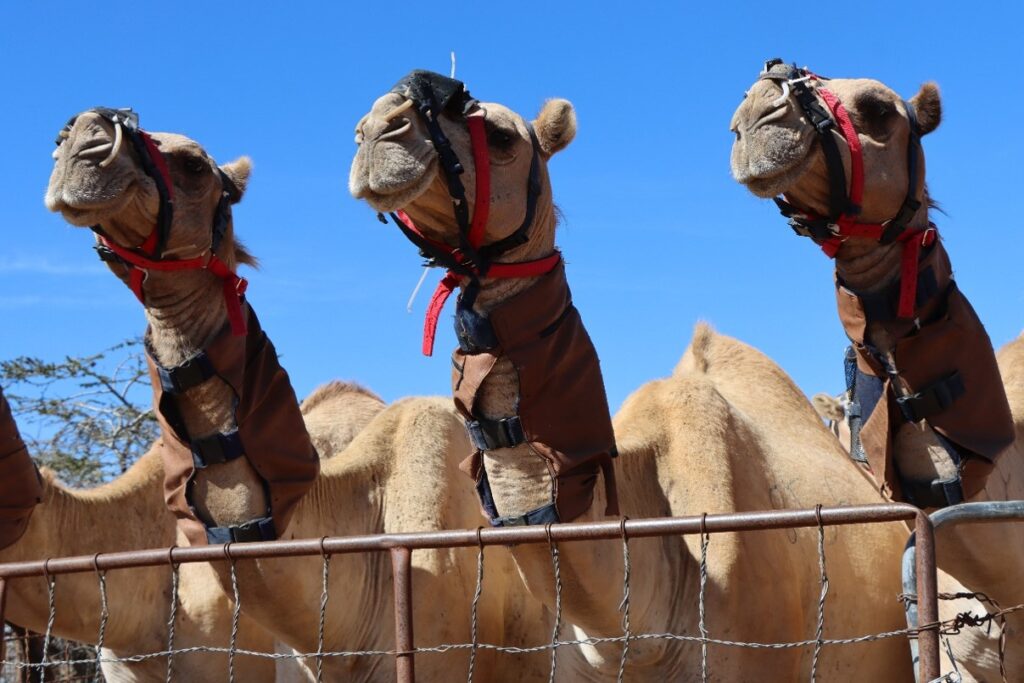

The 24 camels grazing the drylands of Kapiti in Machakos County, Kenya, this September looked much like any other herd, apart from what they were wearing. Each camel carried a light harness fitted with small canisters that, over 24 hours, slowly filled with its breath. What those canisters held could settle a question Kenya has not been able to answer.
The camels were part of the first trial in Africa to directly measure how much methane camels produce. Researchers from the International Livestock Research Institute (ILRI) and CIRAD (French Agricultural Research Centre for International Development) conducted it over four weeks at ILRI’s Kapiti Research Station and Wildlife Conservancy. Their aim was to answer a question that matters more each year in Kenya’s drylands: are camels good for the climate, or bad for it?
Kenya now has more than 4 million camels, and the number is growing. As recurring droughts and rising temperatures weaken cattle, sheep and goats, pastoralist families in arid and semi-arid areas are adding camels to their herds. The animals tolerate heat, scarce water and poor forage, and keep producing milk when other livestock falter.
“Pastoral communities are among the hardest hit by climate change,” said Dr Mohamed Habibou Assouma, a joint appointment scientist at ILRI. “Their cows, sheep and goats are struggling to cope with repeated droughts, so camels are stepping in.”
Camels have long had a reputation for being more climate-friendly than other animals, but the claim has never been tested in Africa. “We have long believed that camels are climate-friendly animals, but we have never had the data to prove it,” Assouma said.
Proving it comes down to one gas: methane. Like cattle, camels ferment their food in their stomachs and release the gas, mostly by belching. Over a century, methane is approximately 28 times more potent than carbon dioxide at warming the planet.
Yet there is little locally generated data on how much methane African camels produce. That leaves countries unable to account accurately for camel emissions in their national climate reports. Kenya relies instead on default figures from the Intergovernmental Panel on Climate Change (IPCC), based on data from other countries.
As more herders switch to camels, that gap is becoming harder to ignore: Kenya cannot say with confidence what the shift means for its methane emissions.
Measuring the emissions of a free-grazing camel is not straightforward. The researchers’ answer was to catch the methane where it leaves the animal.
Each camel swallowed a small tube that slowly released a harmless tracer gas, sulphur hexafluoride (SF6), at a known rate. “Think of it as a slow leak,” Assouma said. “Because we know exactly how much gas the tube releases each day, we can use it to measure the methane.”
The canisters on the harness collected the camel’s breath over 24 hours without changing how it normally grazed in the drylands. In the laboratory, scientists compared the SF6 in each sample with the methane to analyze how much the camel releases in a day. They also recorded each camel’s milk yield, weight and feed intake, and took samples of the microbes in its stomach.
Total emissions are only part of the picture, Assouma said. “What really matters is how much methane is produced per litre of milk and per kilogram of feed. That will show whether camels are climate-friendly or not.”
How productive the camels are could make a big difference. Animals that give little milk or meat release more methane for every litre or kilogram they produce. If camels follow the same pattern, healthier, better-fed animals could give families more milk through droughts while cutting methane emissions per litre of milk.
When it comes to coping with a hotter, drier climate, camels have already proved their worth. Whether they also help limit global warming will not be known until the trial results are published.
For the first time, the findings will give Kenya its own figures on the climate impact of its camels, instead of relying on default numbers from other countries. They could also help herders breed camels that give more milk while producing less methane for every litre.
A second trial, with a new group of Somali camels, is planned for the 2027 rainy season to capture how diet and season change methane emissions. The researchers hope other African countries will be able to share and adopt the evidence on camel methane emissions.
For Assouma, the work is about more than climate accounting. “Camels should not be seen as a last resort,” he said. “They should be a strategic solution to climate change. That is why we need more evidence and more research on camel production and methane emissions.”
The camel methane measurement trial research is implemented under the Regional Livestock Programme, funded by the French Development Agency (AFD) and implemented with Mercy Corps, with additional support from the CGIAR Climate Action Science Program.