
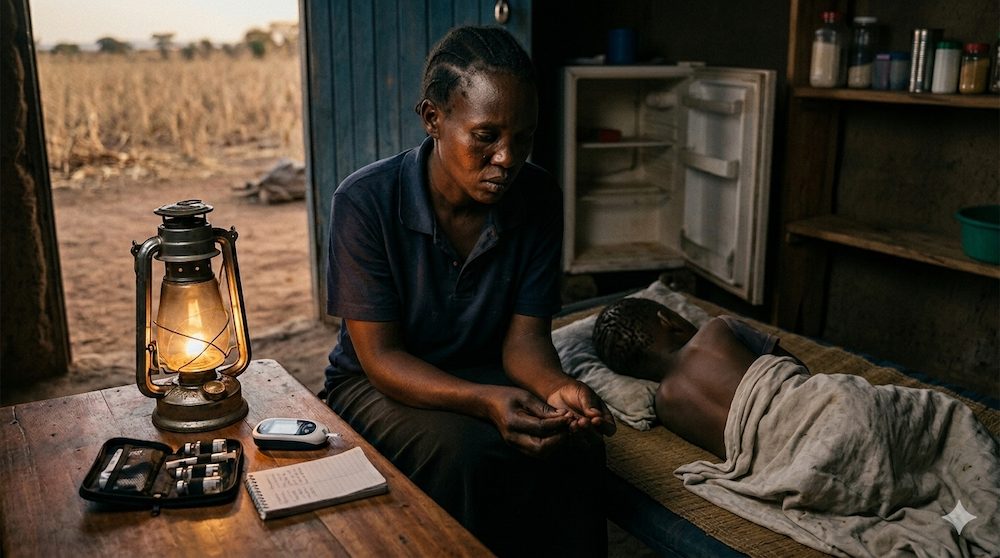

On most nights, while other parents sleep uninterrupted, Hottensiah wakes up every two hours to check whether her son is still safe.
The ritual begins with a glucometer, insulin, and fear.
Her son, Kellab, 3, was diagnosed with Type 1 diabetes on December 8, 2025, a day she says shattered the emotional certainty she once carried as a mother.
“Immediately he was diagnosed, I felt like my life had crumbled,” she says quietly. “I hate seeing him struggling or sick.”
Before the diagnosis, Kellab had been energetic and healthy. Nothing appeared wrong until Hottensiah noticed subtle changes like weight loss, excessive thirst, and frequent urination. At first, she dismissed it as part of normal growth.
“I thought maybe he was becoming taller,” she recalls.
But within weeks, his blood sugar levels spiraled dangerously high, triggering a medical emergency. At the hospital, doctors referred the family to a diabetes management centre, where a diabetes educator at became one of her strongest pillars of support.
“He walked the journey with me,” she says. “I would call him now and then just to ask questions and let him know how Kellab was doing.”
According to clinical psychologist Miriam Wanjiku, parents raising children with Type 1 diabetes often become emotionally dependent on constant reassurance because the condition demands continuous vigilance. She explains that caregivers must constantly calculate carbohydrates, administer insulin injections, monitor blood sugar fluctuations, prepare emergency snacks, and remain alert for dangerous drops in sugar levels, even during the child’s sleep.
And for many parents, survival becomes a full time psychological occupation.
“Managing the sugars begins from the time he wakes up to the time he sleeps and wakes up again,” Hottensiah.
Her words echo the lived reality of thousands of caregivers globally who describe chronic exhaustion, hypervigilance, and anxiety as part of parenting children with Type 1 diabetes.
A typical day for her involves checking Kellab’s sugar levels before meals, administering insulin, monitoring his food intake, and testing his blood sugar again two hours later. At night, the monitoring continues to avoid hypoglycemia, dangerously low blood sugar that can lead to seizures, unconsciousness, or death if left untreated.
“With diabetes, you don’t fall into slumber and lose yourself in it,” she says. “You have to keep checking how he is doing after every two hours.” weight loss, excessive thirst, and frequent urination. At first, she dismissed it as part of normal growth: “I thought maybe he was becoming taller,” she recalls.
But within weeks, his blood sugar levels spiralled dangerously high, triggering a medical emergency. At the hospital, doctors referred the family to a diabetes management centre, where a diabetes educator became one of her strongest pillars of support.
“He walked the journey with me,” she says. “I would call him now and then just to ask questions and let him know how Kellab was doing.”
According to clinical psychologist Miriam Wanjiku, parents raising children with Type 1 diabetes often become emotionally dependent on constant reassurance because the condition demands continuous vigilance.
Wanjiku explains that caregivers must constantly calculate carbohydrates, administer insulin injections, monitor blood sugar fluctuations, prepare emergency snacks, and remain alert for dangerous drops in sugar levels, even during the child’s sleep.
And for many parents, survival becomes a full-time psychological occupation. “Managing the sugars begins from the time he wakes up to the time he sleeps and wakes up again,” Hottensiah.
Her words echo the lived reality of thousands of caregivers globally who describe chronic exhaustion, hypervigilance, and anxiety as part of parenting children with Type 1 diabetes.
A typical day for her involves checking Kellab’s sugar levels before meals, administering insulin, monitoring his food intake, and testing his blood sugar again two hours later. At night, the monitoring continues to avoid hypoglycemia, dangerously low blood sugar that can lead to seizures, unconsciousness, or death if left untreated.
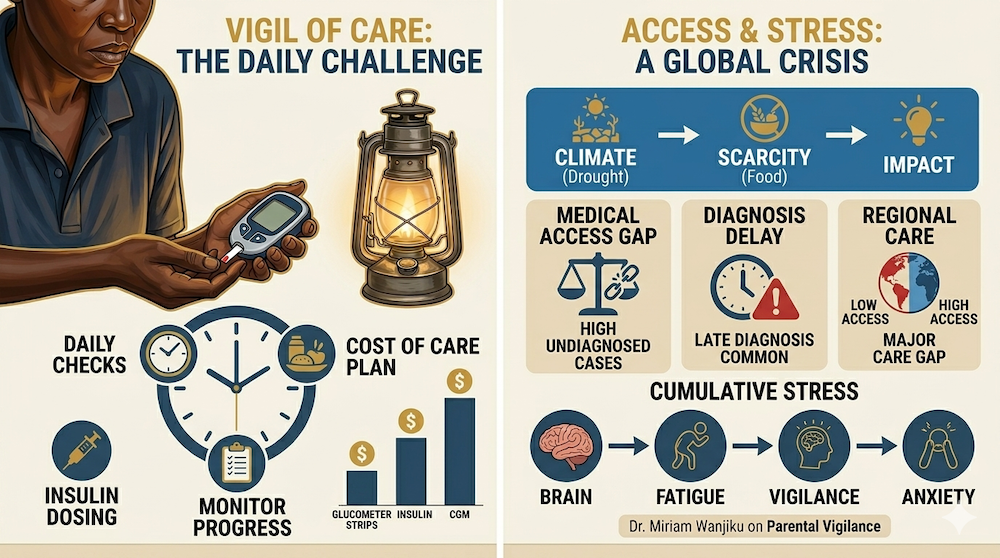
“With diabetes, you don’t fall into slumber and lose yourself in it,” she says. “You have to keep checking how he is doing every two hours.” The emotional cost is immense.
“The constant thought and worry have affected me mentally,” she says. “I keep thinking about him every second. What is he eating? Are his sugars okay?”
For 37-year-old Emmy, not her real name, the emotional strain intensified when both of her sons, now aged 10 and 13, were diagnosed with Type 1 diabetes several years apart.
Her first son was diagnosed in June 2017. Her second followed in February 2020. “Life changed completely,” she says. “Emotionally, it was heartbreaking and traumatic.” She remembers the fear and confusion that settled over her household almost overnight.
“Suddenly, our daily life depended on insulin injections, blood sugar monitoring, strict meal planning, and constant attention.”
The emotional cost is immense.
“The constant thought and worry has affected me mentally,” she says. “I keep thinking about him every second. What is he eating? Are his sugars okay?”
For 37 year old Emmy, not her real name, the emotional strain intensified when both of her sons, now aged 10 and 13, were diagnosed with Type 1 diabetes several years apart.
Her first son was diagnosed in June 2017. Her second followed in February 2020.
“Life changed completely,” she says. “Emotionally, it was heartbreaking and traumatic.”
She remembers the fear and confusion that settled over her household almost overnight.
“Suddenly our daily life depended on insulin injections, blood sugar monitoring, strict meal planning, and constant attention.”
Today, her days revolve around monitoring blood sugar levels, counting carbohydrates, preparing school supplies, and watching for emergencies. Her nights are fragmented by fear.
“I often wake up to check their blood sugar to avoid dangerous highs or lows while they sleep,” she says.
The emotional exhaustion, she explains, is difficult for outsiders to understand.
“Even when they seem fine, as a parent you are constantly thinking about their sugar levels, food, medication, and possible emergencies.”
According to Dr. Wanjiku, parents of children with Type 1 diabetes often experience what experts call “caregiver hypervigilance.”
“These parents live in a permanent state of anticipation,” she explains. “They are always preparing for the next low sugar episode, the next emergency, the next hospital visit. The body and mind rarely get a chance to rest.”
She says many caregivers develop symptoms associated with chronic anxiety, sleep deprivation, burnout, and trauma.
“Some parents experience panic attacks, depression, guilt, and emotional exhaustion,” Dr. Wanjiku says. “There is also fear of making mistakes because insulin management is literally life saving treatment.”
The diagnosis itself can also trigger grief.
“Parents mourn the life they imagined for their child,” she explains. “There is grief for lost normalcy, lost spontaneity, and the fear of an uncertain future.”
Both Hottensiah and Emmy describe feelings that align closely with this psychological experience.
“Immediately he was diagnosed, I fell into trauma and I had to seek counselling,” Hottensiah says.
Emmy says there are moments she cries privately, then gathers herself again because her children need her strength.
“There were moments I felt afraid I may lose them,” she says. “But at the same time I had to stay calm for them.”
Dr. Wanjiku says emotional support for parents is often neglected in diabetes care.
“The focus is usually on the child’s physical health, but parents are carrying enormous emotional weight,” she says. “They also need counselling, peer support, and spaces where they can talk honestly about fear and exhaustion.”
But the burden of Type 1 diabetes extends far beyond insulin injections and sleepless nights.
According to Immaculate Nyaugo, climate change, food insecurity, and poverty are increasingly making diabetes management more difficult for vulnerable families.
Nyaugo says managing diabetes requires consistent access to nutritious food in the right proportions, something many low income households in Kenya struggle to maintain.
“Food security is very critical for all populations,” she explains. “To manage diabetes, we need food available at any given time in appropriate proportions.”
But climate related shocks such as droughts and floods have disrupted food production across the country, making nutritious foods harder to access. According to Nyaugo, many families now depend on cheaper, energy dense foods because healthier options such as fruits and vegetables are increasingly expensive or unavailable.
“When people do not know what tomorrow holds, they tend to eat whatever is available and sometimes in excess,” she says. “That negatively impacts diabetic clients.”

For children with Type 1 diabetes, the challenge is even greater.
“We need the right proportions for this child, and we need foods that provide adequate nutrients,” Nyaugo explains. “But because of climate impacts, people are now producing foods that grow fast and fill stomachs rather than foods that are nutrient dense.”
For mothers like Hottensiah, nutrition has become one of the hardest balancing acts. Children with Type 1 diabetes require stable meals to help regulate blood sugar, yet restricting food entirely is impossible for growing children.
“He needs all the nutrients to grow,” Hottensiah says. “He is active and I cannot avoid starch completely.”
Nyaugo warns that low income households are disproportionately affected because they are often forced to choose between affordability and nutrition. Cheap processed foods, sugary beverages, bread, and wheat products have become more accessible than healthier alternatives.
“These foods are affordable even for low income populations,” she says. “But they do not add value to a diabetic client.”
The effects of climate instability stretch beyond food itself. Floods and droughts also disrupt healthcare access, particularly in remote and underserved communities.
“In the recent floods, some roads were cut off and people could not access clinics or medication,” Nyaugo explains. “Some facilities even closed because healthcare workers themselves were affected.”
She says pastoralist communities in northern Kenya have been particularly vulnerable. During drought periods, families often migrate with livestock in search of pasture, leaving women and children behind without stable food supplies or income.
“If the cows move away, milk is no longer available for the family,” she says. “That migration affects women and children most.”
Healthcare workers supporting children with Type 1 diabetes say the financial burden on families is already overwhelming even without climate related disruptions.
Eunice Munyiri, a clinical officer at the Kenya Diabetes Management and Information Centre (DMI), an implementing partner of the Changing Diabetes in Children (CDiC) programme supported by the World Diabetes Foundation, says the cost of insulin remains one of the biggest challenges facing caregivers.
“Most parents do not have stable jobs, so even affording insulin becomes difficult,” the nurse explains.
To bridge some of the gaps, DMI organizes subsidized clinic days and supports children and young adults with insulin, glucometers, and diabetes supplies whenever resources allow.
The centre also runs psychosocial support forums for parents and children.
“We have psychologists who help families navigate their concerns,” the nurse says.
However, myths, misinformation, and stigma continue to isolate many caregivers.
“One of the biggest misconceptions is that people think diabetes is caused simply by eating too much sugar or poor parenting,” Emmy says.
Others wrongly assume the condition is temporary or curable.
“The hardest misconception is knowing that it’s not treatable and we can only manage it,” Hottensiah says.
Nyaugo believes communities already possess important indigenous knowledge that could help families cope better with food insecurity and chronic illness.
She says older generations understood how to prepare balanced meals using locally available foods, but that knowledge has gradually been ignored.
“Our grandmothers knew how children should be fed,” she says. “We have devalued indigenous knowledge on food.”
She argues that community health systems should place greater emphasis on nutrition education and prevention rather than focusing almost entirely on medication.
“The government prioritizes treatment,” she says. “But these are people who just need information on how to manage themselves nutritionally.”
According to Nyaugo, strengthening community health workers and local support systems could significantly reduce the burden on families living with diabetes.
“If preventive nutrition strategies were emphasized, many patients could reduce dependence on medication,” she says.
For parents already carrying the emotional weight of constant monitoring, these broader structural failures deepen the strain.
Financial pressure, emotional exhaustion, food insecurity, and fear often collide in the same household.
But despite the exhaustion, many families continue to survive through resilience, faith, and support networks.
Hottensiah says family support has made survival possible.
“My mum and dad have also learned how to manage him,” she says. “Now I am able to work because I know someone is taking care of him.”
|Emmy says faith and community support continue to sustain her family.
For Dr. Wanjiku, these support systems are essential.
“When caregivers feel supported emotionally and socially, their mental resilience improves significantly,” she says. “No parent should carry this burden alone.”