


More than half of farmers and agricultural workers in East Africa may suffer unintentional acute pesticide poisoning each year, according to a new global study that places the region among the world’s worst-affected areas.
The study, published in Frontiers in Public Health on September 2, estimates that 53.5 per cent of East Africa’s farming population experiences acute pesticide poisoning annually. This translates into about 49.3 million non-fatal cases across the region.
Kenya’s estimated prevalence is 35.1 per cent. The rates are considerably higher in Malawi at 78 per cent, Tanzania at 70.8 per cent and Uganda at 66 per cent. Ethiopia recorded the lowest estimate among the six East African countries covered, at 26 per cent.
The findings indicate that pesticide poisoning is a major but poorly documented occupational health crisis across Africa, where millions of smallholder farmers and farm workers routinely handle agrochemicals with limited protection, training or access to healthcare.
Researchers Wolfgang Boedeker, Meriel Watts, Peter Clausing and Emily Marquez reviewed studies published between 2006 and 2023 and combined the findings with mortality data from the World Health Organisation (WHO).
The researchers estimate that between 402 million and 433 million cases of unintentional acute pesticide poisoning occur worldwide every year, alongside approximately 11,000 deaths. With the global farming population estimated at 934 million, the findings suggest that about 46 per cent of farmers and farm workers are poisoned annually.
Southern Asia recorded the largest estimated number of non-fatal cases, followed by South-East Asia and East Africa.
Across Africa, the study estimates approximately 115 million non-fatal cases each year. Besides East Africa’s 49.3 million cases, West Africa accounts for an estimated 30.6 million, Central and Southern Africa 24.8 million, and North Africa 10.3 million.
Country estimates vary sharply. Burkina Faso recorded Africa’s highest estimated prevalence at 83.8 per cent, followed by Malawi, Tanzania and Nigeria, where the rate was put at 69 per cent.
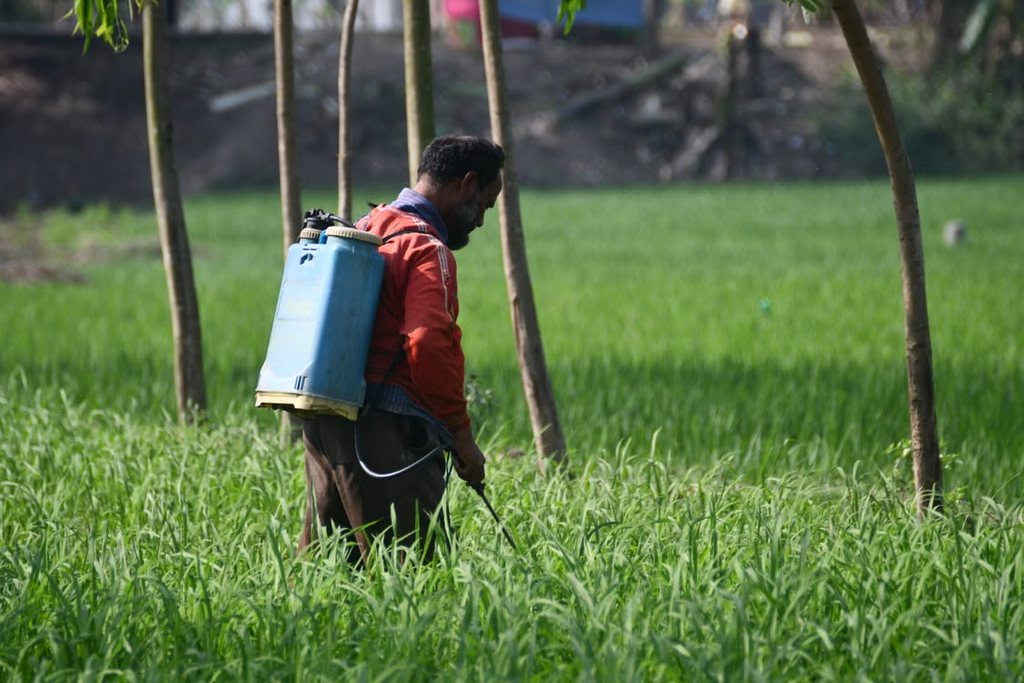
Acute poisoning refers to illness or other health effects occurring shortly after suspected or confirmed exposure to a pesticide. Reported symptoms can include headaches, nausea, dizziness, skin irritation, breathing difficulties and more severe neurological or respiratory complications.
The researchers warned that official figures substantially understate the problem because many affected people do not seek medical treatment.
“Farmers may lack money, transport, health insurance or nearby medical facilities. Some also continue working for fear of losing income, while health workers may mistake pesticide poisoning for other illnesses or fail to report cases,” state the report.
Africa’s actual burden may therefore be higher than the study estimates because calculations based on formal agricultural employment may exclude subsistence farmers and informal workers, who make up a large share of the continent’s agricultural labour force.
The assessment comes as pesticide consumption in Africa has risen by 185 per cent since 1990, compared with a worldwide increase from 1.8 million tonnes to 3.8 million tonnes by 2023.
The study calls on governments to strengthen national poisoning surveillance, require health facilities to report pesticide-related cases and distinguish between farmers, other workers and children in official records.
It also urges countries to implement the Food and Agriculture Organisation’s (FAO) recommendation to phase out highly hazardous pesticides. Under the United Nations-backed Global Framework on Chemicals, countries have set a 2035 target for phasing out such pesticides in agriculture where their risks cannot be adequately managed.
The researchers argue that relying on protective clothing is often unrealistic for small-scale farmers, particularly where the equipment is expensive, unavailable or uncomfortable in hot climates. Where highly toxic pesticides remain in use, they recommend mandatory training, certification and an obligation on employers to provide suitable protective equipment.