
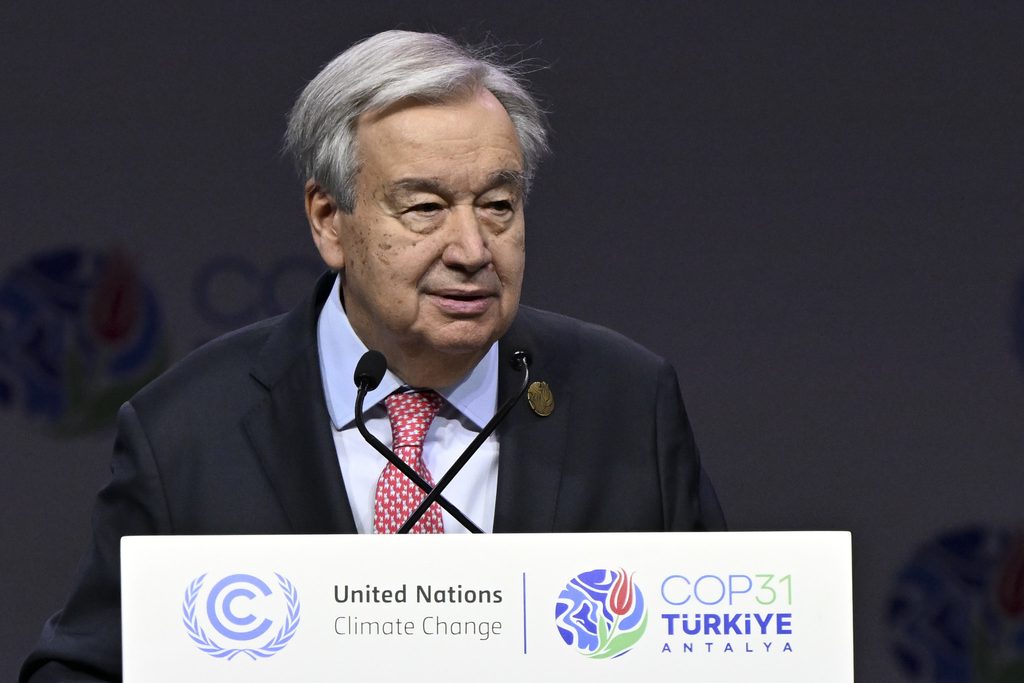

UN Secretary-General António Guterres has called for a new global Climate Justice Compact to unlock climate finance for developing economies, warning that Africa and other vulnerable regions cannot accelerate the transition to clean energy or withstand worsening climate impacts without affordable funding.
Addressing the COP31 Leaders’ Summit in Antalya, Türkiye, on November 11, Guterres said the global energy transition was advancing too slowly and remained deeply unequal, with developing economies receiving a disproportionately small share of investment despite accounting for a substantial proportion of the world’s population.
He noted that emerging and developing economies outside China are home to nearly two-thirds of humanity but attract less than one-fifth of global clean-energy investment. These countries also pay two to three times more to borrow than wealthier economies, making it harder to finance renewable energy infrastructure.
Guterres warned that without affordable financing, developing countries could remain dependent on fossil fuels to meet growing energy demand, locking in emissions for decades. “We cannot demand that countries transform their economies while denying them the means to do so,” he said, proposing a Climate Justice Compact based on shared responsibility, shared security and shared benefits.
The proposal comes as African countries continue to press for greater access to climate finance, arguing that their development needs and exposure to climate impacts are not adequately reflected in the global distribution of investment.
Guterres said the global transition away from fossil fuels must account for the different economic circumstances of countries, with developed economies expected to cut emissions faster while providing finance and technology to developing nations.
He called for an accelerated but just and orderly transition to renewable energy, warning against policies that overlook the energy needs of populations still struggling with inadequate electricity access.
Three-quarters of the world’s population live in countries that import fossil fuels, he said, leaving them vulnerable to international price shocks and geopolitical instability.
Guterres argued that clean energy was increasingly economically competitive, but cautioned that technological progress alone would not deliver the transition, accusing fossil fuel interests of using their influence to delay climate policies and undermine accountability. “The dinosaurs did not have a lobby. But fossil fuels do,” he said.
He urged governments to develop credible national roadmaps for moving away from fossil fuels, including ending new coal projects, avoiding new oil and gas infrastructure that would undermine the 1.5°C target, cutting methane emissions and rapidly expanding renewable energy, electricity grids and storage.
Beyond energy investment, Guterres placed climate adaptation and loss and damage at the centre of the proposed Climate Justice Compact, calling for a new generation of national adaptation plans, supported by the international community, and universal access to early warning systems.
He also demanded faster and more accessible funding for communities and countries experiencing climate-related loss and damage, particularly where the impacts exceed their capacity to adapt. He said the scale of the challenge required developed countries to deliver at least $300 billion annually in climate finance by 2035 and establish concrete plans to triple adaptation finance by the same year.
In a pointed intervention on climate finance, Guterres called on governments to tax windfall profits made by fossil fuel companies and channel the proceeds towards supporting vulnerable countries.
The UN chief also warned that geopolitical rivalry, trade barriers and restrictions on access to technology could undermine developing countries’ ability to benefit from the global energy transition.
Guterres said the world was already on course to exceed the 1.5°C warming threshold agreed under the Paris Agreement, but stressed that the extent and duration of the overshoot remained within humanity’s influence.
He warned that existing national climate plans, even if fully implemented, would deliver only about a third of the annual emissions reductions required to keep global warming within safer limits.
As he prepares to leave office next year, Guterres urged African and other developing countries, young people, scientists, Indigenous Peoples and civil society organisations to maintain pressure on governments and powerful commercial interests.
He said the next decade must deliver a transition that addresses climate change while advancing sustainable development, peace, security and human dignity. “I will not stop telling the truth. And I will not stop fighting for it,” he said, pledging to remain an advocate for climate action after leaving the position of UN Secretary-General.