
By Mathew Stewart
United Nations Secretary-General António Guterres has called on wealthy nations, development banks and private investors to significantly increase support for Africa’s clean energy ambitions, warning that the continent risks being left behind in the global transition from fossil fuels.
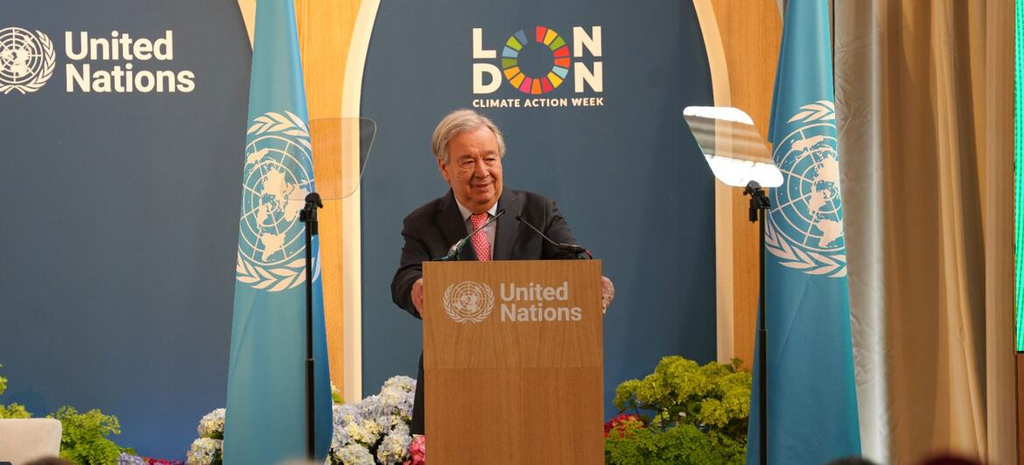
Speaking during London Climate Action Week, Guterres argued that Africa’s development prospects and the world’s climate goals are deeply interconnected, making it imperative for the international community to unlock the financing, technology and investment needed to accelerate the continent’s shift to renewable energy.
“Africa must not be left behind,” Guterres said as he unveiled what he described as a practical blueprint for a global clean energy transition.
The UN chief noted that while Africa is home to some of the world’s richest solar, wind and renewable energy resources, hundreds of millions of people across the continent still lack access to reliable electricity.
He said this paradox highlights the urgent need for greater international support to help African countries harness their clean energy potential while advancing economic growth and sustainable development.
Guterres warned that without adequate financing, developing countries could struggle to participate fully in the global energy transition, widening existing inequalities and undermining efforts to tackle climate change.
His remarks come at a time when many African nations are grappling with rising energy demand, mounting climate impacts and limited access to affordable climate finance.
Despite contributing only a small fraction of global greenhouse gas emissions, African countries remain among the most vulnerable to climate-related disasters, including droughts, floods and extreme weather events.

The Secretary-General called for increased public and private investment in renewable energy projects across the continent, alongside reforms to international financial systems that would make climate finance more accessible and affordable for developing countries.
Beyond Africa, Guterres outlined a broader roadmap for accelerating the global shift to clean energy. The blueprint calls for a rapid expansion of renewable energy generation, greater electrification of transport and industry, and stronger national climate commitments ahead of the COP31 climate summit in Antalya, Türkiye.
“The age of fossil fuels is failing us,” he said, arguing that renewable energy has become the most viable path to energy security, economic resilience and sustainable development.
He noted that the cost of renewable technologies continues to fall, creating unprecedented opportunities for countries to reduce emissions while strengthening their economies.
According to Guterres, clean energy is no longer simply an environmental imperative but an economic opportunity that countries cannot afford to ignore.
The UN chief also urged technology companies to power their rapidly expanding data centres with renewable energy and called on oil and gas producers to reduce methane emissions by eliminating routine flaring and fixing leaks throughout their operations.
As global leaders prepare for COP31, Guterres emphasized that the success of the clean energy transition will depend not only on ambitious targets but also on ensuring that developing regions, especially Africa, have the resources needed to turn those ambitions into reality.
“The time for setting targets alone is over,” he said. “What the world needs now is delivery.”
His message places Africa at the centre of the global climate conversation, framing the continent not as a victim of climate change but as a critical partner in building a cleaner, more sustainable energy future.